Traditional methods have limited visibility.
Security marks can help, but they often provide limited feedback after products enter the market. Brands may not know where products are scanned or when suspicious activity begins.
 TrustQR TrustQR
 TrustQR helps brands deploy an anti-counterfeit QR code system to verify unit authenticity, detect duplicate scans, monitor suspicious scan clusters, and stop counterfeit packaging before it reaches buyers.
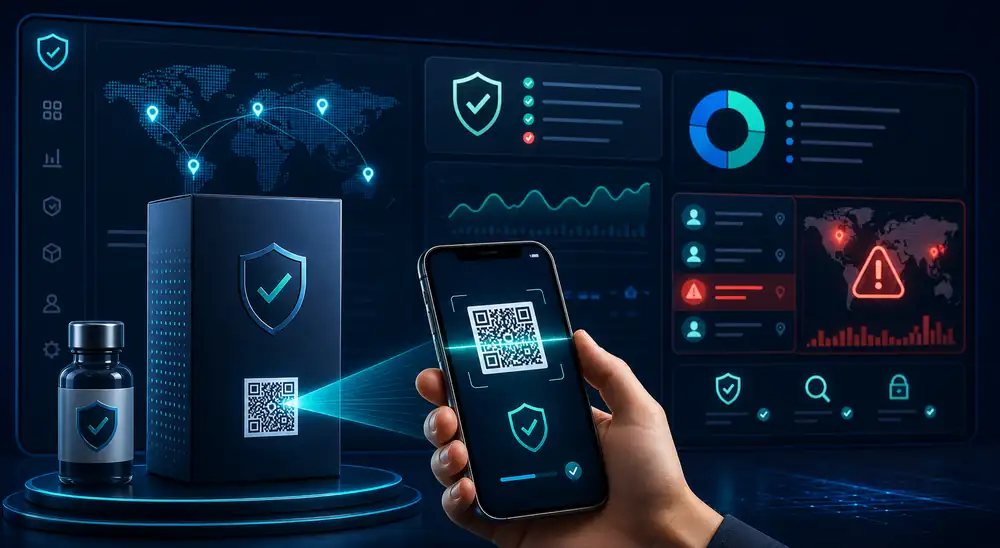
An anti-counterfeit QR code system (also called an anti-copy or copy-proof QR code system) connects each product QR code to a secure record, then checks scan history, duplicate activity, location signals, and product status to help brands detect copied codes and suspicious counterfeit behavior.
TrustQR combines anti-counterfeit QR code authentication, duplicate scan detection, scan analytics, and verification workflows to help brands strengthen product security and customer trust.
Use anti-counterfeit QR codes on product packaging
Detect suspicious product activity
Improve counterfeit visibility
Support product authentication
Strengthen brand protection
Increase customer confidence
Gain scan intelligence
Monitor product verification activity
An anti-counterfeit QR code system gives each product a scannable identity and checks that identity against live product records, scan history, and copied-code signals.
Security marks can help, but they often provide limited feedback after products enter the market. Brands may not know where products are scanned or when suspicious activity begins.
Digital verification, duplicate scan detection, and analytics help brands identify suspicious behavior and investigate counterfeit risk signals faster.
Any QR code can be photographed and reprinted, so no printed code is physically copy-proof. What an anti-copy QR code system does is make the copy useless and visible: a copied anti-counterfeit code fails verification and reveals where the counterfeit is being sold.
| Approach | Can it be copied? | What happens to a copy |
|---|---|---|
| Static QR code (same code on every pack) | Yes, instantly | Passes every check — the fake looks genuine |
| Hologram or security label | Yes, within weeks | Buyer cannot tell; brand never finds out |
| Serialized anti-counterfeit code without monitoring | Yes | Passes if the serial exists in the database |
| TrustQR anti-copy QR code system | Yes, but detected | Duplicate scan flagged, buyer warned, brand alerted with location |
Every pack gets its own unpredictable serial, so a single photographed code cannot be reused across thousands of fakes without standing out.
The QR code verification system compares each scan with the code's history and flags repeats from new devices, cities, or countries.
Printing the code under a seal, inside the pack, or beneath a scratch-off layer means it cannot be harvested from shelf stock before purchase.
Want the technical detail behind scan validation? See how our product verification technology checks each code, or read what product authentication is and how it differs from basic QR codes.
Counterfeit products affect supplements, pharmaceuticals, cosmetics, electronics, food products, and consumer goods.
Counterfeit products can redirect sales away from legitimate brands.
Fake products can create bad customer experiences that are blamed on the real brand.
Counterfeit medicines, electronics, supplements, and cosmetics can create real safety concerns.
Unauthorized production and diversion can make product movement harder to understand.
TrustQR connects physical products to secure QR verification records and risk monitoring.
Each product receives a unique identifier that connects the physical item to a secure brand-controlled record.
A secure QR code is applied to the product packaging so customers can access verification from a smartphone browser.
Customers scan the code to verify authenticity, product status, and relevant product information before purchase or use.
TrustQR evaluates duplicate scans, suspicious activity, geographic inconsistencies, and verification history.
Brands gain visibility into product verification activity and can investigate signals that may indicate counterfeit risk.
Independent references show why counterfeit risk matters for brand protection, safety, and customer trust.
OECD and EUIPO research reports that counterfeit and pirated products create substantial economic losses for legitimate businesses.
Counterfeit products can weaken customer confidence and damage long-term brand reputation.
The World Health Organization has highlighted dangers associated with counterfeit medicines and healthcare products.
Counterfeit electrical products, chargers, batteries, and electronics may create overheating and electrical failure risks.
Brands need visibility into counterfeit activity, and consumers want confidence that products are genuine.
TrustQR helps improve transparency, monitor product activity, support investigations, reduce uncertainty, and improve customer confidence.
Anti-counterfeit verification helps consumers reduce purchasing uncertainty, verify authenticity, and access trusted product information from a smartphone.
TrustQR combines anti-counterfeit monitoring, authentication, and verification in a cloud-based platform.
An electronics manufacturer distributes products across multiple countries. Each product receives a unique TrustQR code, and customers verify products before use.
Repeated scans from several unrelated markets can suggest copied packaging, diversion, marketplace counterfeits, or unauthorized distribution.
TrustQR gives the brand visibility into suspicious activity so the team can investigate further.
Static marks can support packaging checks, but anti-counterfeit programs need monitoring and analytics.
| Feature | Security Label | Hologram | Basic QR Code | TrustQR |
|---|---|---|---|---|
| Product Verification | Limited | Limited | Yes | Yes |
| Authentication | Limited | Limited | Partial | Yes |
| Duplicate Detection | No | No | No | Yes |
| Scan Analytics | No | No | No | Yes |
| Suspicious Activity Monitoring | No | No | No | Yes |
| Dashboard | No | No | No | Yes |
Anti-counterfeit systems support product categories where authenticity, safety, and trust matter.
Protect high-demand products from imitation.
Improve authenticity verification.
Reduce counterfeit risk for premium brands.
Monitor product authenticity.
Increase transparency and trust.
Support anti-counterfeit initiatives.
TrustQR helps brands monitor signals connected to copied packaging, unauthorized production, and suspicious distribution.
TrustQR is operated by TrustQR Ltd, a UK-registered SaaS company focused on product verification, product authentication, anti-counterfeit protection, scan intelligence, and brand protection.
17272910
Direct answers for brands comparing anti-counterfeit QR codes, authentication, and scan intelligence.
An anti-counterfeit QR code is a product code connected to a secure verification record, scan history, and duplicate scan monitoring rather than only a static webpage.
An anti-copy QR code is a QR code designed so that copies can be detected. Because any QR code can be photographed, the protection comes from giving every unit a unique serialized code and flagging any code that is scanned again in a different place or pattern.
No printed QR code is physically copy-proof. A copy-proof system is one where a copied code is useless: each code is valid once per unit, verified in the cloud, and a duplicate scan triggers a counterfeit warning to the buyer and an alert to the brand.
An anti-counterfeit code is a unique identifier printed on each product unit — usually a serialized QR code, Data Matrix, or hidden PIN — that a buyer can verify against the manufacturer database to confirm the item is genuine.
Scan it and check the verification result. A genuine serialized code opens the brand verification page and shows a first-scan confirmation; a counterfeit or copied code shows a prior-scan history, a different location, or an already-verified warning.
An anti-counterfeit system helps brands reduce counterfeit risks and improve product authenticity verification using identification, QR code authentication, monitoring, and analytics.
They combine product serialization, secure QR codes, verification workflows, duplicate scan detection, risk analysis, and brand-side intelligence.
QR codes can support verification and authentication workflows when connected to unique records, validation logic, and duplicate scan monitoring.
Supplements, pharmaceuticals, cosmetics, electronics, food products, and consumer goods can use anti-counterfeit systems.
Duplicate scan detection identifies situations where the same code is scanned repeatedly, unexpectedly, or from unrelated regions.
Scan intelligence gives brands visibility into verification activity and suspicious behavior that static labels cannot provide.
No. Product verification can be completed using a standard smartphone browser.
They can help improve transparency and confidence by giving customers a clear way to verify authenticity.
Yes. TrustQR is designed to scale across products, batches, brands, and markets.
Continue from anti-counterfeit monitoring into product verification, authentication, and brand protection.
Detect suspicious activity, improve authenticity verification, and help protect your products from counterfeit risks.
These references support the market, safety, and standards context behind anti-counterfeit systems, QR code product verification, and brand protection monitoring.