
Quick Answer
Why manufacturers still delay anti-counterfeit authentication and how incentives, regulation, and QR verification can close the adoption gap.
Back to Blog
INDUSTRY ADOPTION
14 min read
The Adoption Gap: Why Most Manufacturers Still Don’t Use Anti-Counterfeit Authentication and How to Change That
Why manufacturers still delay anti-counterfeit authentication and how incentives, regulation, and QR verification can close the adoption gap.
The Adoption Gap: Why Most Manufacturers Still Don’t Use Anti-Counterfeit Authentication and How to Change That
Industry Adoption
Why manufacturers still delay anti-counterfeit authentication and how incentives, regulation, and QR verification can close the adoption gap.
QUICK ANSWER
Why manufacturers still delay anti-counterfeit authentication and how incentives, regulation, and QR verification can close the adoption gap.
Introduction: A Strange Paradox
We live in a moment in which:
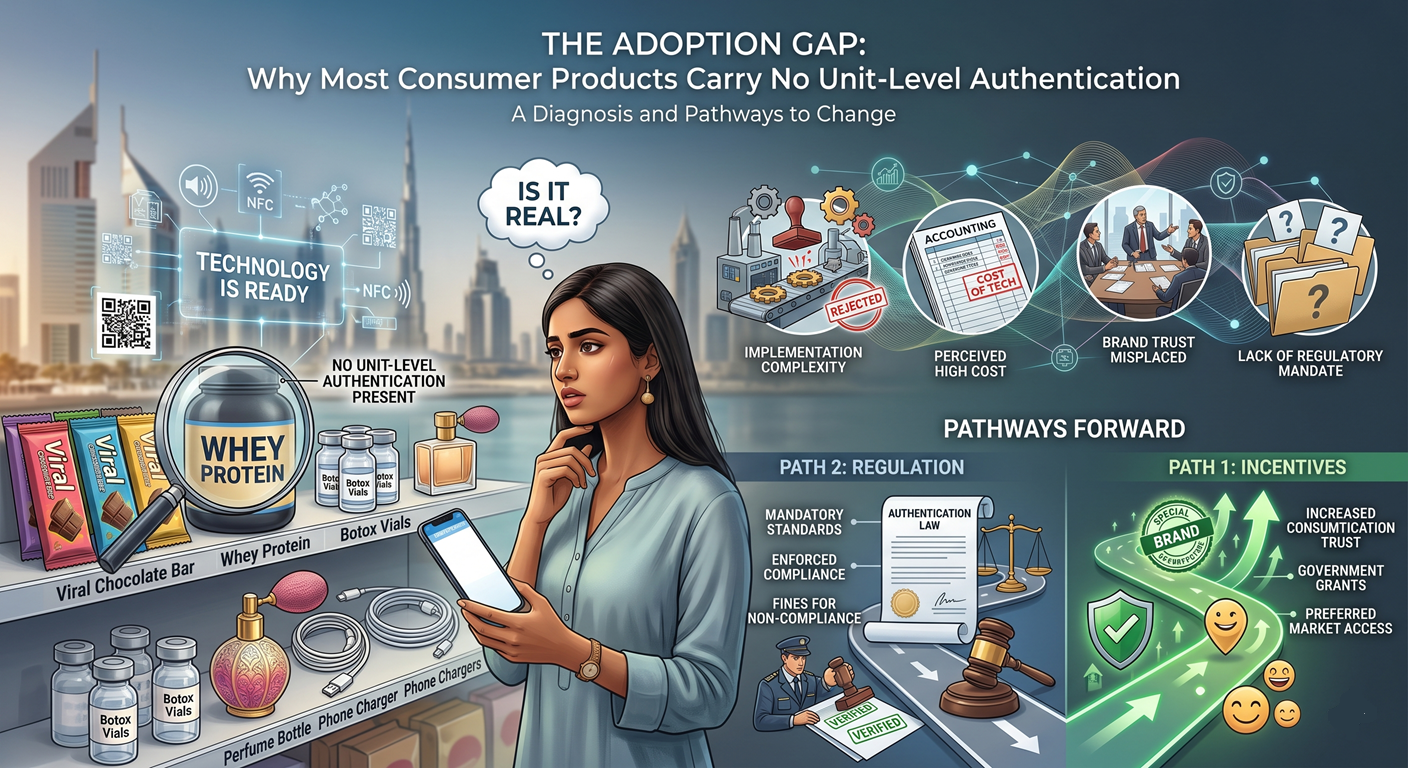
And yet, the overwhelming majority of consumer products on shelves and in online marketplaces today carry no unit-level authentication of any kind. A consumer in Dubai who buys a viral chocolate bar, a tub of whey protein, a Botox vial, a perfume bottle, or a phone charger has, in most cases, no way to scientifically verify that the product is genuine before paying for it or using it.
The technology gap is closed. The adoption gap is the real problem.
This article is a diagnosis. It asks why so many manufacturers including some who are themselves being damaged by counterfeit operations still do not deploy authentication on their products. It examines the structural, financial, cultural, and regulatory reasons. And it lays out two complementary paths forward: how to encourage adoption through incentives, and how to mandate it through regulation.
Counterfeit trade has reached USD 467 billion globally and is projected to climb toward USD 1.79 trillion by 2030.
Eleven people in the United States were hospitalized in 2024 from counterfeit Botox; arsenic-laced sweets, antifreeze-laced medicine, and lead-laced lipstick have a documented 2,500-year lineage; counterfeit protein powders are seized by the kilogram from Indian backstreets.
The technology to authenticate any individual product unit, in seconds, from any smartphone, exists, is mature, is affordable, and is in active commercial use.
Part 1 The Pathology: Eight Reasons Manufacturers Don’t Adopt
After reviewing industry analyses, case studies, and the academic literature on technology adoption among SMEs and brand owners, eight recurring reasons emerge.
1. “It costs too much.”
This is the most-cited objection and the most overstated. Smaller generic manufacturers have long argued that serialising hundreds of millions of packs is a heavy fixed cost relative to thin margins, especially for low-priced products. One often-cited Irish study of pharmaceutical serialisation under the EU Falsified Medicines Directive (FMD) estimated a 2.7% increase in cost of goods sold a number that frightened many smaller players.
But the numbers have moved. Cloud-based authentication platforms and QR-code-based unit serialisation now add as little as $0.01 to $0.03 per unit at scale. Hologram-and-paper solutions of the 1990s cost more than that. For most consumer-product categories, the cost per unit of cryptographic authentication is now lower than the cost of the label it’s printed on.
2. “It’s not my problem it’s customs, the regulator, the police.”
This is the most structurally damaging belief. It treats counterfeiting as a public-sector enforcement problem, like smuggling or terrorism. But every customs authority in the world publishes the same finding: over 90% of counterfeit seizures now happen in small parcels and express courier channels that no border inspection regime can realistically police at scale. The U.S. CBP itself acknowledges that small-parcel volume has overwhelmed twentieth-century inspection models.
The brand is the only party that can verify its own product. If the brand does not provide that verification mechanism, no one else can.
3. “Holograms and a serial number on the box are enough.”
This is the comforting illusion. As one analysis bluntly notes, holograms “look impressive but are increasingly easy to counterfeit” and “provide zero data back to the brand.” Optimum Nutrition’s TRU Seal six-digit-code SMS system is one of the more sophisticated industry attempts at consumer authentication and yet the 2026 Delhi raid recovered hologram labels, neck seals, and brand stickers being industrially reproduced in a single illicit unit. Static visual marks cannot phone home. They cannot detect themselves being copied. They cannot map a counterfeit outbreak in real time.
4. “If we adopt it, we admit we have a problem.”
This is the reputational fear. Brand managers worry that putting “scan to verify authenticity” on a package implicitly acknowledges that fakes exist. In reality, every premium brand on Earth already has a documented counterfeit problem; consumers know this; and the brands that turn authentication into a feature rather than a defensive disclaimer consistently outperform those that hide from it. Luxury houses like Louis Vuitton have already done this at scale.
5. “Counterfeiters won’t bother with us we’re too small.”
The empirical record is the opposite. The Indian state of counterfeiting data from ASPA and CRISIL shows that 89% of urban Indian consumers have bought a counterfeit product at least once and that 25–30% of products in their local markets are counterfeit by consumer perception. This is not a luxury-brand problem. Cumin seeds, cooking oil, packaged sweets, mid-range cosmetics, and generic supplements are all in the data. Counterfeiters operate on margin, not prestige. If a product moves volume, it gets copied.
6. “We tried QR codes they didn’t work.”
Some authentication systems genuinely don’t work and skeptics are right to call this out. A static QR code printed on a label can be photographed, replicated, and put on a million fake jars. As one critique puts it, counterfeiters do not even need to copy the original QR code they print their own, route the scan to a clone of the brand’s authentication website, and the consumer gets a green checkmark on a fake product.
The lesson is not that QR-based authentication doesn’t work. The lesson is that only cryptographically unique, server-validated, copy-detecting QR systems work. Static QR codes are marketing. Dynamic, serialised, copy-protected QR codes are authentication. The two are constantly confused, and the confusion drives bad procurement decisions.
7. “There’s no regulation forcing us, so it’s not urgent.”
In most consumer-product categories outside pharma, this is currently true. Pharmaceuticals are mandated under the U.S. DSCSA, the EU FMD, China’s serialisation regime, India’s TTSP pilots, Russia’s Chestny ZNAK, and 78+ other national regimes. But cosmetics, supplements, food, electronics, and most other categories have either no mandate or only voluntary guidance.
The result is a classic collective action problem: every individual brand reasons that adopting authentication while competitors do nothing is a unilateral cost increase. So almost no one moves first.
8. “Our internal organisation can’t agree on who owns it.”
This is the underrated reason. Anti-counterfeit authentication touches packaging, IT, supply chain, marketing, legal, and finance simultaneously. In a typical mid-sized manufacturer, no single executive has clear ownership of the problem, no single department has the budget, and every department has an excuse. The project simply never moves.
Part 2 The Real Costs of Not Adopting
The pathology above produces a predictable outcome: brand owners underestimate the cost of inaction. The data tells a very different story.
When the inaction cost is honestly tallied, the “it costs too much” argument inverts. Not authenticating is the more expensive option for almost every meaningful brand.
Direct revenue loss. OECD–EUIPO estimates put displaced legitimate economic activity from counterfeiting at approximately $1.1 trillion in 2022 alone, with $174 billion in lost worldwide sales-tax revenue and 4.2–5.4 million jobs lost. For an individual brand, sector studies consistently show counterfeit penetration costs 1.4% to 5% of legitimate sales far more than the 0.1–0.3% that unit-level authentication adds in implementation cost.
Brand-trust collapse. A widely cited industry survey found that 41.5% of consumers who were tricked into buying a counterfeit version of a product never buy that brand again, 32% disengage from its social posts, and 26% stop trusting its promotional discounts. The brand reputation hit outlasts any single counterfeit batch.
Legal and regulatory exposure. A 2025 legal analysis notes that protein-supplement brands now face FTC warning letters, FDA enforcement, and class actions when products bearing their trademark even counterfeits are found to contain unsafe levels of lead. The legal exposure of not having unit-level traceability is rising fast.
Recall and crisis-management cost. A brand without unit-level authentication, faced with a contamination event, must recall the entire product line across all geographies. A brand with unit-level authentication can do a surgical recall of the specific affected batch often saving tens of millions of dollars in a single recall event.
Part 3 How to Encourage Adoption (The Carrots)
If the problem is partly structural and partly cultural, the solutions must be structural and cultural too. Four levers consistently work.
Carrot 1 Make the ROI undeniable
The most powerful single case study in the field comes from Nigeria’s pharmaceutical sector. Through coordinated deployment of physical and digital authentication solutions, including track-and-trace, counterfeit rates in some key medicines fell from nearly 20% to 3.5% within three years. That is not a marketing slide; that is a public-health outcome with a quantifiable economic value. Industries that publish similar case studies pharma, cosmetics, electronics accelerate voluntary adoption across their entire sector.
Carrot 2 Make the technology cheaper and simpler
The dramatic fall in per-unit authentication cost over the past five years is the single biggest reason adoption is now feasible for SMEs. Cloud-based platforms, smartphone-only verification (no special hardware), and SaaS subscription models have collapsed the entry barrier. The job of the authentication-platform industry is to keep that curve moving downward, and the job of governments and trade associations is to make sure SMEs know the curve has moved.
Carrot 3 Turn authentication into a marketing asset
Authentication-enabled packaging produces scan rates 3 to 5 times higher than traditional marketing channels because consumers actually engage with it. That means every authentic scan is a verified consumer touchpoint: data the brand can use for loyalty programs, repurchase prompts, geographic demand mapping, and direct-to-consumer engagement. The authentication system pays for itself as a CRM and marketing layer even before the counterfeit-protection value is counted.
Carrot 4 Use government and trade-association support
Governments around the world already subsidise SME technology adoption through grants, low-interest loans, and tax credits Yale School of Management’s survey of post-COVID SME-support programmes documented Malaysia’s RM 3 million-per-firm financing at 4% interest, Spain’s €200 million ICO credit line, and South Korea’s 1 trillion won small-business loan facility, among others. Extending these instruments explicitly to brand-protection technology would cost very little and would tip the cost-benefit calculation for hundreds of thousands of SMEs.
Trade associations can do the same internally. A sector-wide voluntary code in which the top ten brands in a category jointly commit to unit-level authentication creates competitive pressure that no individual brand could create alone and protects all of them.
Part 4 How to Mandate Adoption (The Sticks)
The carrots alone are not enough. Where the harm is severe medicines, ingestible products, injectables regulation has been, and will continue to be, the decisive lever.
The pharmaceutical industry is the proof of concept. As of 2026, more than 78 countries worldwide mandate serialisation and traceability for pharmaceutical products. The two anchor regimes are:
The same logic is now extending beyond pharma:
The lessons from a decade of pharmaceutical mandates are clear:
The most credible path forward, sector by sector, is to extend the pharma template:
U.S. Drug Supply Chain Security Act (DSCSA), signed in 2013, with full electronic interoperable traceability enforced from 27 May 2025 after a multi-year stabilisation period. Manufacturers must apply unique serial numbers and expiration dates in human- and machine-readable format; wholesalers and pharmacies must verify each transaction electronically.
EU Falsified Medicines Directive (FMD), in force since 9 February 2019. Every prescription pack must carry a tamper-evident feature and a 2D DataMatrix barcode, and pharmacies must verify each pack at the point of dispense by querying the European Medicines Verification System (EMVS).
China’s National Medical Products Administration introduced comprehensive cosmetic regulations in 2021 imposing unit-level requirements on the cosmetics sector.
The U.S. FDA’s New Era of Smarter Food Safety Blueprint explicitly promotes real-time traceability and track-and-trace for food, and FSIS requirements are pushing serialisation across the meat and poultry industries.
India’s Track and Trace System (TTSP) is being rolled out, beginning with vaccines and exports, and is expected to broaden.
The UAE’s Tatmeen platform has already mandated pharmaceutical serialisation and verification across the country.
-
Mandates work. Where serialisation is enforced, counterfeit penetration measurably falls.
-
Mandates need stabilisation periods. The FDA itself extended DSCSA enforcement multiple times to allow trading partners to mature their systems. Smart regulators give industry 18–36 months to prepare.
-
Mandates need to align across borders. The greatest practical challenge cited by global brands is the variation across markets. Convergence on the GS1 standard (GTIN-based identification) is the single most important technical step regulators can take.
-
Mandates must be paired with consumer-side enforcement. A serial-number scan at the pharmacy counter, or at the point of injection, is what closes the loop. Without verification at the consumer interface, serialisation becomes a back-office cost with no consumer-protection benefit.
Cosmetics and injectables are the obvious next category the FDA counterfeit-Botox alert of April 2024 is exactly the kind of event that historically precedes a regulatory mandate.
Dietary supplements are not far behind, with the FDA already issuing warning letters over heavy-metal contamination and undeclared pharmaceutical ingredients.
Premium food categories wine, olive oil, single-origin coffee, infant formula are strong mandate candidates because the consumer-safety risk and brand-protection value align.
Part 5 A Closing Diagnosis
The honest diagnosis is this: anti-counterfeit authentication is no longer a technology problem. It is a decision problem.
Manufacturers who do not adopt authentication are not, in most cases, making a financial calculation. They are making a cognitive calculation under-weighting the cost of counterfeiting because it is diffuse and slow, over-weighting the cost of authentication because it is concrete and immediate, and deferring action because no regulator has yet forced them.
The history of the field tells us how that decision changes. It changes when:
Modern authentication platforms TrustQR among them are now positioned at exactly that intersection. They make adoption affordable for SMEs, simple for IT teams, valuable for marketing, and credible for consumers. What is missing is the demand-side push from regulators, trade bodies, retailers, and consumers and the supply-side willingness from brands to stop treating counterfeit protection as a defensive cost and start treating it as a competitive feature.
The brands that close the adoption gap first will not just protect themselves. They will turn authentication into the same competitive advantage that “Made in” stamps, hallmarks, and trademarks once provided a small, unforgeable mark of trust that travels with the product wherever it goes.
The technology is here. The data is in. The history is clear. What remains is the decision.
A regulator passes a mandate (pharmaceutical serialisation, after the 1937 Elixir Sulfanilamide deaths and the 1906 Pure Food and Drug Act).
A high-profile event makes the cost concrete (counterfeit Botox hospitalisations, fake protein powder raids, Dubai chocolate scams).
The cost of the solution falls below the cost of inaction (the current cloud-based, smartphone-verifiable inflection point).
A trusted competitor adopts and is rewarded for it.
Sources & Further Reading
These external references support the article topic and help readers verify the broader research context behind product verification, counterfeit risk, consumer safety, or supply chain protection.
OECD–EUIPO, Mapping Global Trade in Fakes 2025
Corsearch / Frontier Economics, Global Counterfeit Goods Market to Hit $1.79 Trillion by 2030
ProPharma Group, “What is the Drug Supply Chain Security Act (DSCSA)?”
IntuitionLabs, DSCSA vs. EU FMD: A Pharma Serialization & Traceability Guide
IntuitionLabs, FMD Explained: A Guide to Pharma Serialization & Barcodes (78+ country mandates; Irish study 2.7% COGS impact)
SoftGroup, World map showing pharmaceutical serialization regulations by country status 2026
Axway, Are You Ready for Serialization/DSCSA Compliance? (FDA stabilization period and DSCSA timeline)
Pharmaceutical Technology, Decoding Serialization Regulations
Systech, The EU Falsified Medicines Directive (FMD) compliance revisited
Ennoventure, Anti-Counterfeiting Technology Trends 2026 (3–5× scan rates; layered defences)
BasiQR, Anti-Counterfeiting QR Codes: How Brands Fight Fakes in 2026 (NFC vs QR economics; static vs dynamic)
iTRACE Technologies, Why QR Code based systems will never work for product authentication (the static-QR critique)
Kimdee Foods, QR Code Product Authentication for Food Brands (per-unit cost $0.01–$0.03)
Yale School of Management, Governments Encourage SMEs to Adopt New Technology (Malaysia RM 3M, Spain €200M ICO, South Korea 1 trillion won)
ASPA, State of Counterfeiting in India (Nigeria pharma 20% → 3.5% case study)
ASPA / Crisil, State of Counterfeiting in India 2025 (89% urban-consumer fake-purchase rate; sector breakdown)
Emergen Research, Anti Counterfeit Cosmetics Packaging Market Size, Share & Growth Report (cloud-based access for SMEs; China NMPA 2021)
U.S. FDA, Counterfeit Version of Botox Found in Multiple States, April 16, 2024
Climate Solutions Legal Digest, Protein Maxing, Lead Contamination, and the Law
U.S. CBP, The Truth Behind Counterfeits (90%+ of seizures in small parcels and express courier)
Related TrustQR pages
Continue with the QR product verification workflow, review anti-counterfeit platform features, or compare QR code and contactless tag pricing.