
Quick Answer
How counterfeit Botox caused hospitalizations and why product-level verification matters for injectables, cosmetics, and consumer safety.
Introduction
In April 2024, the U.S. Food and Drug Administration issued an urgent safety alert: counterfeit versions of Botox had been found in multiple U.S. states and injected into consumers for cosmetic purposes. A week later, the Centers for Disease Control and Prevention escalated the alert to a Health Alert Network advisory (HAN-00507). The numbers were stark: 22 people across 11 states had reported adverse effects, all females aged 25 to 59, and 11 of them had been hospitalized.
The product they had paid for was the most famous cosmetic injectable in the world. What they had actually received was a vial that was nearly indistinguishable in appearance from the real thing, manufactured by criminals, injected in non-medical settings, and pharmacologically capable of triggering systemic botulism a disease that can progress to total paralysis and, in serious cases, death.
This article tells the story of how counterfeit Botox happened, quantifies the financial and reputational damage to AbbVie (the brand’s owner) and to the broader $570+ billion cosmetics industry, surveys the regulatory and academic research on counterfeit beauty products, and concludes with the only solution capable of structurally closing the gap.
The Brand: Why Botox Is the Most Counterfeited Cosmetic Injectable on Earth
Botox is the brand name for onabotulinumtoxinA, a purified botulinum toxin manufactured by AbbVie (which acquired Allergan, the original developer). It is sold under tight regulatory control in two licensed dose presentations 50-unit and 100-unit vials and is approved for cosmetic indications such as the temporary reduction of facial wrinkles, as well as for a range of therapeutic uses.
Three properties make Botox the perfect counterfeit target:
That last point is what makes Botox uniquely dangerous as a counterfeit category. With a fake lipstick, the consumer at least gets to inspect the tube. With a fake injectable, the product goes from a sealed vial directly into the patient’s facial muscles.
-
Extreme price-to-volume ratio. A vial smaller than a thimble can command hundreds to over a thousand dollars per injection session, depending on units used and provider mark-up. The raw materials a counterfeiter needs are trivially cheap relative to that retail value.
-
Visual replicability of the packaging. The vial and outer carton are small, the label is short, and the visual cues consumers rely on (logo, branding, dose marking) can be reproduced at high fidelity.
-
Trust transferred from the clinic. Most patients never see the vial up close. They trust the injector, who is trusted because they “use Botox.” If a med-spa or unlicensed injector is willing to use a fake, the patient has almost no way to know.
The Counterfeit Wave: A Documented Public-Health Event
The 2024 U.S. outbreak is one of the most thoroughly documented counterfeit-beauty events on record because both the FDA and the CDC published detailed advisories.
According to the FDA alert dated April 16, 2024 and the CDC HAN advisory dated April 23, 2024:
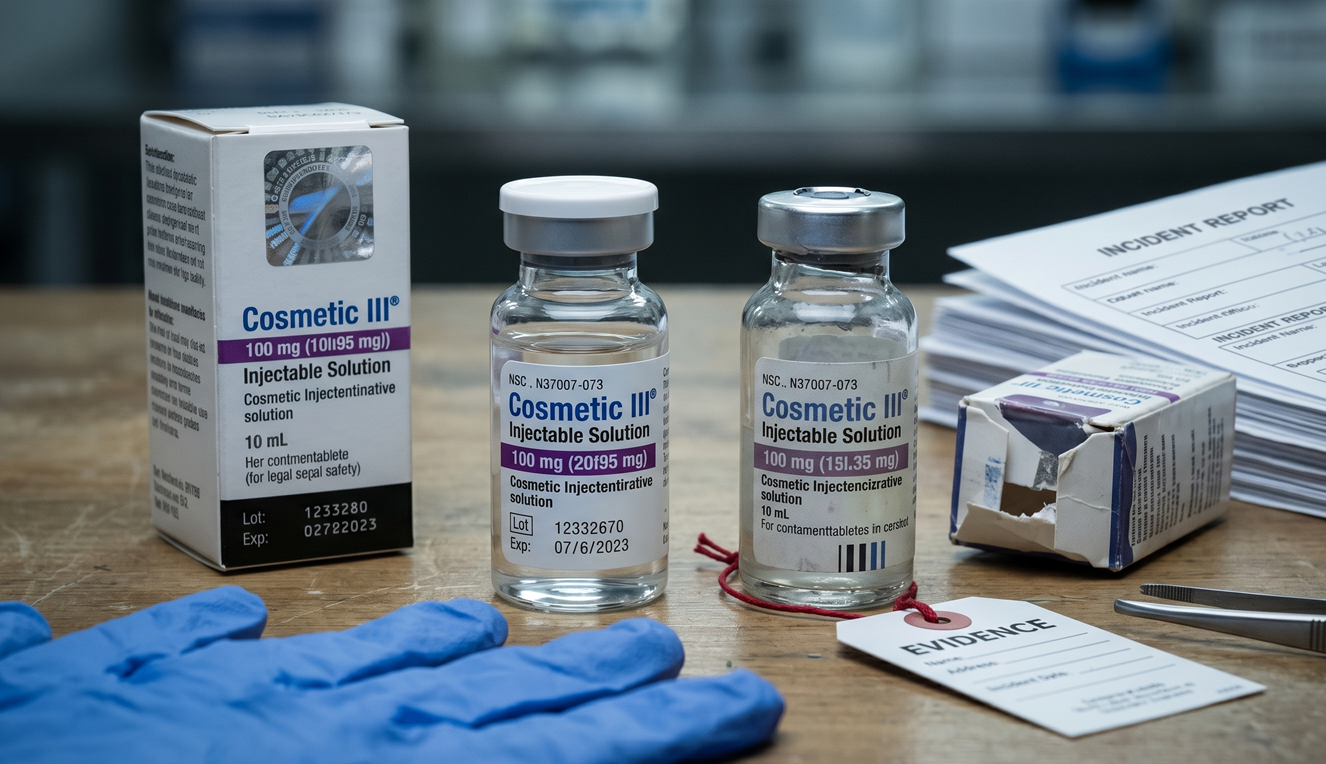
The FDA also published the specific physical markers of the counterfeit product, which is instructive about how good these fakes have become:
In other words: the only way a clinician let alone a patient could reliably catch this counterfeit was to know the exact name of the active ingredient, the legal dose presentations, and the lot-numbering convention of a single manufacturer. The visual cues alone were nearly perfect.
Counterfeit Botox was found in multiple U.S. states and administered to consumers for cosmetic purposes.
The FDA was aware of adverse events, including hospitalizations, linked to the counterfeit product.
Reported symptoms included blurred or double vision, difficulty swallowing, dry mouth, constipation, incontinence, shortness of breath, weakness, and difficulty lifting one’s head symptoms consistent with botulinum toxin spreading beyond the intended injection site.
The CDC investigation identified 22 people in 11 states (California, Colorado, Florida, Illinois, Kentucky, Nebraska, New Jersey, New York City, Tennessee, Texas, and Washington) with adverse effects after injection.
11 patients were hospitalized; no deaths were reported.
All symptomatic people were females aged 25 to 59, and 91% (20 of 22) had received the injections for cosmetic purposes.
All affected patients had received injections from unlicensed or untrained individuals, or in non-healthcare settings such as homes or spas.
Outer carton and vial bearing lot number C3709C3.
The active ingredient labelled as “Botulinum Toxin Type A” instead of the correct “OnabotulinumtoxinA”.
150-unit doses a presentation that AbbVie and Allergan do not manufacture.
Outer carton text in a language other than English.
The Health Damage: When a Counterfeit Beauty Product Becomes a Botulism Outbreak
Counterfeit beauty products in general are documented to cause meaningful harm but Botox sits at the most extreme end of the spectrum.
Botulism from counterfeit Botox. The clinical signature reported in the CDC outbreak is the classic presentation of botulism: blurry or double vision, droopy eyelids, difficulty breathing, fatigue, slurred speech, and hoarse voice symptoms that can progress to total paralysis and, in serious cases, be fatal. One dermatologist quoted in Dermatology Times described counterfeit Botox as “an extremely scary injectable” capable of resulting in systemic botulism and even death.
Heavy metals, chemical burns, and biological contamination in fake cosmetics more broadly. Laboratory testing by the UK Intellectual Property Office in 2024 on seized counterfeit beauty products found samples containing carcinogenic ingredients, rodent urine, and equine faeces. The U.S. Department of State and FDA have documented counterfeit cosmetics containing lead and mercury in lipsticks and skin-lightening creams; DEHP, a probable human carcinogen, in counterfeit perfumes; arsenic and beryllium in counterfeit eye makeup capable of causing chemical burns, eye infections, and long-term vision damage; industrial-grade chemicals in counterfeit skincare leading to permanent scarring and hormonal disruption; and bacterial and biological contamination including faecal matter in counterfeit foundations and concealers.
Allergic reactions, chemical burns, and infections. The Personal Care Products Council documents that counterfeit cosmetics have been linked to allergic reactions, skin irritation, chemical burns, eye infections, and “more severe health repercussions.” A counterfeit mascara has been documented to cause eye infections that consumers blamed on the legitimate brand a textbook example of brand reputation being damaged by a product the brand never made.
Consumer-trust collapse. Survey data summarised by industry analysts indicates that 41.5% of buyers who were tricked into purchasing counterfeit cosmetics never buy that brand again, 32% stop engaging with its social posts, and 26% stop trusting its promotional discounts entirely.
In short: a counterfeit Botox vial is not a cheaper alternative to the real thing. It is a vial of unknown, unregulated, potentially neurotoxic content being injected into a patient’s face by someone who in most cases is not even legally allowed to inject anything.
Estimating the Financial Damage
The damage operates on three levels.
1. The size of the legitimate market being siphoned
The global cosmetics and personal care market was valued at approximately USD 571 billion in 2023, and counterfeit cosmetics and perfumes were the third most commonly seized items at the European Union’s external borders in 2019. Injectable cosmetics like Botox sit at the highest margin of the highest-margin segment of that market.
2. The documented industry-wide losses
The OECD and the Personal Care Products Council estimate that the global cosmetics industry loses approximately USD 5.4 billion every year to counterfeit cosmetics.
An AlpVision analysis estimates cosmetic companies suffered €4.7 billion (≈ USD 5.16 billion) in lost sales in 2020 specifically due to counterfeiting.
The European Union Intellectual Property Office, in a January 2024 report, estimated lost cosmetics sales attributable to counterfeiting at €3 billion, equal to 4.8% of total sector sales. The French cosmetics industry alone reportedly loses €800 million per year.
In 2023, U.S. Customs and Border Protection, alongside the FDA, seized over USD 700 million worth of counterfeit cosmetics entering the United States.
A separate market study found that 67% of branded beauty items tested on e-commerce platforms were likely counterfeit.
3. A reasoned estimate for the Botox segment specifically
Applying the OECD’s 4.8% lost-sales share to AbbVie’s Botox cosmetic franchise which alone generates several billion dollars in annual revenue yields a defensible working estimate of hundreds of millions of dollars per year in direct revenue loss to AbbVie from counterfeit and unauthorised botulinum-toxin products globally, before recall costs, FDA-investigation cooperation costs, brand-reputation damage, and class-action exposure are added.
Add the consumer-side losses medical bills for hospitalisation, lost wages, and long-term injury from the 11 patients hospitalised in the 2024 outbreak alone and the cost of a single counterfeit incident escalates into the millions before any criminal prosecution is even brought.
Research Summary
Across the FDA, CDC, OECD, EU IPO, UK IPO, Personal Care Products Council, Corsearch, and AlpVision, the findings converge on four points:
The structural gap is exactly the same one that exists in counterfeit chocolate and counterfeit sports supplements: there is no real-time, product-level, consumer-facing way for the end user to know, before injection or before use, that the specific unit in front of them is the genuine article.
-
Counterfeit beauty products are a multi-billion-dollar global industry, with the cosmetics sector losing ~$5.4 billion every year to fakes.
-
Counterfeit cosmetics carry uniquely severe health risks chemical burns, eye infections, heavy-metal toxicity, and, in the Botox case, systemic botulism and hospitalisation.
-
Visual authentication is no longer sufficient. The 2024 counterfeit Botox vials could only be reliably identified by knowing the exact lot number, the official active ingredient name, and the legal dose presentations of a single manufacturer knowledge no patient and very few clinicians possess.
-
Existing regulatory tools are reactive. The FDA alert was issued after patients were hospitalised, not before. By the time a HAN advisory goes out, the harm has already happened.
The Definitive Solution: TrustQR
TrustQR closes that gap.
For an injectable beauty brand operating in the same threat environment as Botox high price, mass demand, life-impacting clinical risk if counterfeited TrustQR delivers what FDA alerts, customs seizures, and visual lot-number checks structurally cannot:
In a beauty industry losing $5.4 billion every year to counterfeits and where, in the Botox case, the cost is paid in hospital beds, not just in lost sales the brands that will retain consumer trust are the ones whose customers can prove, on demand, that what is about to touch their face, their eyes, or be injected into their muscles is real.
A lot number printed on a carton cannot do that. An FDA alert published two weeks after eleven hospitalisations cannot do that.
TrustQR can. One scan. One vial. One verified, traceable, counterfeit-proof truth before the cap ever comes off. That is what stops the next counterfeit beauty outbreak from becoming the next emergency room admission, and what gives every legitimate beauty brand back the revenue, the reputation, and the consumer trust that counterfeiters have been stealing for years.
Vial-level cryptographic authentication. Each individual vial carries a one-time, non-clonable QR identity. A scan from any smartphone confirms in real time whether this specific vial is genuine, which authorised distributor handled it, and which cold chain it travelled through.
Pre-injection verification. Both the clinician and the patient can scan the vial before the needle ever enters the skin. The patient is no longer asked to trust a label they cannot decode they receive a real-time, cryptographic “yes” or “no” on screen.
Real-time outbreak detection. Suspicious scan patterns vials scanned outside authorised distribution territories, vials scanned in non-medical settings, codes scanned multiple times are flagged automatically. The brand and the regulator see the counterfeit event forming before the 12th hospital admission, not after.
Surgical recalls and outbreak containment. When a counterfeit lot is identified as lot “C3709C3” was in the 2024 alert every vial of that fake batch can be instantly blacklisted across the network, and every legitimate vial confirmed in seconds, eliminating the painful weeks of uncertainty that followed the original FDA notice.
Brand-protection intelligence. Every legitimate scan becomes a verified consumer touchpoint geographic demand data, clinic-level distribution insights, and counterfeit-hot-spot mapping that informs enforcement priorities.
Regulatory alignment. Unit-level traceability aligns directly with the direction the FDA, EMA, and EU IPO are already moving for medicinal and high-risk cosmetic products.
Sources & Further Reading
These external references support the article topic and help readers verify the broader research context behind product verification, counterfeit risk, consumer safety, or supply chain protection.
U.S. Food and Drug Administration, Counterfeit Version of Botox Found in Multiple States, alert dated April 16, 2024 (updated April 18, 2024)
U.S. Centers for Disease Control and Prevention, Adverse Effects Linked to Counterfeit or Mishandled Botulinum Toxin Injections, Health Alert Network advisory CDCHAN-00507, April 23, 2024
Dermatology Times, “FDA Issues Alert on Counterfeit Botox: What Dermatology Clinicians Need to Know.”
Healio, “As counterfeit Botox cases rise, health officials continue to warn clinicians of risks,” April 25, 2024
Partnership for Safe Medicines, “U.S. officials warn about botulism-like illness linked to counterfeit Botox.”
ISAPS (International Society of Aesthetic Plastic Surgery), FDA Botox Advisory
Personal Care Products Council, Counterfeit Cosmetics
Happi, “Counterfeit Cosmetics: How Personal Care & Pharma Industries Are Impacted.”
AlpVision, “Counterfeit cosmetics is worse than gray market.”
CosmeticsDesign Europe, “Fake beauty products hidden risks are underestimated.”
Lexology, “Counterfeit beauty products flood online marketplaces what can brands do?” (citing EUIPO 2024 report and UKIPO laboratory testing)
OneArvo Ventures, Beauty Product Protection in 2026: 7 Proven Strategies to Combat the $5.4 Billion Counterfeit Cosmetics Crisis
The National, “Toxic beauty products could be harming your health here’s how to spot fakes.”
Bytescare, Counterfeit Cosmetics: Risks, Impact & Protection (consumer-trust survey data)
Related TrustQR pages
Continue with the QR product verification workflow, review anti-counterfeit platform features, or compare QR code and contactless tag pricing.