
Quick Answer
How counterfeit Apple and Samsung chargers create fire, shock, and brand-risk problems that product authentication can help reduce.
Back to Blog
ELECTRONICS
16 min read
Plugged Into Danger: How Counterfeit Apple and Samsung Chargers Became One of the Most Dangerous Counterfeit Categories in Your House
How counterfeit Apple and Samsung chargers create fire, shock, and brand-risk problems that product authentication can help reduce.
Plugged Into Danger: How Counterfeit Apple and Samsung Chargers Became One of the Most Dangerous Counterfeit Categories in Your House
Electronics
How counterfeit Apple and Samsung chargers create fire, shock, and brand-risk problems that product authentication can help reduce.
QUICK ANSWER
How counterfeit Apple and Samsung chargers create fire, shock, and brand-risk problems that product authentication can help reduce.
Introduction: The $5 Charger That Could Burn Down Your Home
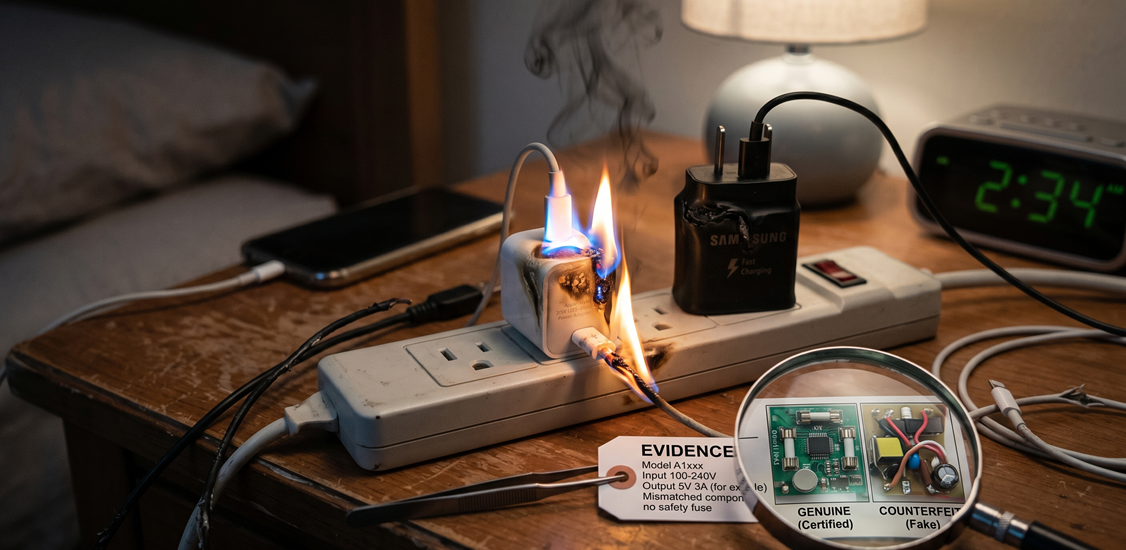
In 2016, Underwriters Laboratories (UL) one of the oldest and most respected product-safety testing organisations in the world ran a series of basic electrical safety tests on 400 counterfeit Apple chargers purchased from online stores around the world. The results were as bad as it is possible for a consumer product to be: 397 of the 400 chargers failed. The overall failure rate exceeded 99%. Twelve of the chargers were so badly designed and built that UL formally classified them as posing a risk of lethal electrocution to the user.
A year later, the UK-based safety body Electrical Safety First, working with Apple, ran the largest study of its kind in the United Kingdom on counterfeit and lookalike iPhone chargers. They tested 50 chargers. 49 of the 50 failed one or more safety tests. More than one in three failed every part of the test. Twenty-three of them failed the basic electric-strength test outright, meaning they could deliver a severe shock the moment a user touched a live part.
In 2025, UK trading standards seized at the border a counterfeit Apple-branded USB-C power adapter (model A1696) classified by the UK Office for Product Safety and Standards as posing a serious risk of fire and electric shock the plug pins were not compatible with British BS 1363 sockets, the unit could overheat, and the live parts were inadequately protected.
The pattern is consistent, well-documented, and global. Counterfeit phone chargers and cables sold as Apple, Samsung, and other major brands are among the most uniformly dangerous counterfeit consumer products on the market. They are made in unregulated factories, sold through e-commerce marketplaces, plugged into walls in millions of homes, and they cause house fires, burn injuries, and in documented cases lethal electrocutions.
This article examines the scale of the problem, the documented health and safety harms, the financial damage to Apple, Samsung, and consumers, the legal response so far, and the structural reason once again that the existing system has not been able to stop it.
Part 1 The Scale: A Charger Black Market the Size of a Mid-Cap Tech Company
The legitimate fast-charger market is enormous and growing fast.
The counterfeit share of this market is staggering by any standard:
The volume context matters: there are roughly two billion smartphones in active use globally, every one of which uses a charger. Even a small percentage of counterfeit penetration in that base is hundreds of millions of dangerous units in circulation.
The global fast-charger market reached approximately $18.7 billion in 2024 and is projected to grow to $48.9 billion by 2032, driven by USB-PD, GaN technology, and the move to high-wattage standards (Samsung’s 45W Super Fast Charging 2.0, Apple’s 20W and 30W USB-C adapters).
Shenzhen produces an estimated 80% of the world’s chargers, both legitimate and counterfeit, often in factories within a few kilometres of each other.
A 2024 Statista report indicates that over 40% of chargers sold online are fakes, leading to 1,200+ battery incidents annually linked to poor-quality charger products.
The USB Charger Safety Task Force documented 217 charger-related fires in 2023, up 25% year-over-year, with 70% linked to non-original products.
The U.S. National Fire Protection Association attributes approximately 24% of all cell phone fires to improper charging or the use of low-quality chargers.
Consumers lose an estimated $2.5 billion per year to damaged devices caused by incompatible or counterfeit power delivery.
One court-documented Apple investigation found that of more than 100 iPhone devices, Apple power products, and Lightning cables sold as genuine by sellers on Amazon.com, 90% were counterfeit, with design flaws that Apple itself documented as creating “risks of overheating, fire, and electrical shock.”
Part 2 The Safety Damage: Documented Fires, Shocks, and Deaths
Counterfeit phone chargers fail in ways that are not subtle. The failure modes are physical, immediate, and well-documented.
The UL findings
UL’s report on counterfeit Apple chargers found that the failures included:
UL’s formal conclusion: counterfeit Apple charging products “lack the safety features necessary to protect users from shock and fire hazards” and have the potential to “overheat, catch fire, and deliver a deadly electric shock to consumers while in normal use.”
Improper soldering of internal wiring.
Missing critical safety fuses to protect against overheating during a power surge.
Inadequate electrical insulation between live components and user-touchable surfaces.
Poor heat dissipation that allowed the unit to overheat in normal use.
Counterfeit UL safety certification markings designed to conceal the dangers a forgery within the forgery.
The Electrical Safety First (UK) findings
In the 50-charger UK study run with Apple’s support:
49 of 50 failed at least one safety test.
23 chargers failed an electric strength test outright meaning severe electric shock risk.
Nearly half failed basic safety requirements with inferior internal components or inadequate spacing risks of electrocution or house fire.
15 chargers contained pins that failed strength tests pins could break off inside a wall socket leaving a live conductor exposed.
Real-world incidents
The lab data is matched by a documented record of real-world harm:
The mechanism is consistent: counterfeit lithium-ion battery and charger products skip the safety vents, insulation, current-limiting circuits, thermal fuses, and fire-retardant materials that authentic products include. Lithium-ion cells can enter thermal runaway when overheated, with cell temperatures of 130°F (54°C) and above documented during normal charging and dramatically higher temperatures during failure events. A counterfeit charger that lacks proper current-limiting or thermal-shutdown circuitry can drive that runaway directly.
London Fire Brigade has formally warned of the dangers of counterfeit iPhone chargers after responding to a house fire in Tottenham caused by an imitation iPhone charger igniting while in use.
2003 Netherlands: A 33-year-old Dutch woman was injured when her Nokia phone exploded in her hands; a supermarket employee suffered burn injuries when his Nokia exploded in his hip pocket two months later incidents that contributed to Nokia’s 2007 recall of 46 million phone batteries.
2004 Kyocera Wireless recalled roughly one million phone batteries after 14 reports of battery failures causing property damage and burn injuries. Some of the failed batteries shipped to Kyocera appeared to have been counterfeit.
2014: A Samsung Galaxy S4 caught fire while under a pillow during the night, set alight by a counterfeit replacement battery. The victim was fortunate to escape serious injury.
2025: More than 400,000 wireless phone chargers were recalled in a single CPSC action over fire hazards, in addition to multiple separate counterfeit-charger seizures by U.S. and UK authorities.
The “two-step harm” pattern
Counterfeit chargers cause two distinct types of injury:
Both are foreseeable. Both are well documented. Neither has been stopped at meaningful scale.
-
Direct injury to the user burns, electric shocks, electrocution, and exposure to flame.
-
Property damage and bystander harm house fires that destroy property and endanger people who never used the charger themselves.
Part 3 Why Apple and Samsung Are the Most Counterfeited Charger Brands
Two structural reasons make Apple and Samsung the dominant counterfeit-charger targets globally.
Reason 1 Massive installed base, massive price differential
A genuine Apple 20W USB-C power adapter retails for approximately $19–24 from the official Apple Store. A genuine USB-C-to-Lightning cable retails for $19–29. A genuine Samsung 45W Super Fast Charging adapter retails for $40–50.
A counterfeit equivalent can be sold for $3–8 online and still leave the manufacturer with a high profit margin, because the cost of the missing safety components, the missing certification testing, and the missing licensing fees is what makes the original product expensive.
This is the same tax-arbitrage logic that drives counterfeit cigarettes except that the “tax” being avoided here is the cost of safety and certification compliance.
Reason 2 The MFi licensing model is itself a target
Apple’s Made for iPhone/iPad/iPod (MFi) licensing program requires third-party accessory makers to pay licensing fees, use Apple-supplied authentication chips inside the cable, and submit products for Apple testing before earning the right to display the MFi logo. The program is genuinely effective at ensuring quality among licensed accessories but it also creates a strong economic incentive for counterfeiters to fake the MFi logo and bypass the licensing system entirely.
Samsung does not operate an exactly equivalent licensing program for its branded chargers, but uses similar authentication mechanisms in its USB-PD PPS implementation for 45W Super Fast Charging 2.0. Counterfeit Samsung chargers routinely fail to negotiate the proper PPS handshake, which can result in the charger delivering the wrong voltage to the device damaging the phone and, in some cases, the battery’s ability to safely accept the charge.
A genuine Apple Lightning cable will display the text “Designed by Apple in California” plus “Assembled in China,” “Assembled in Vietnam,” or “Indústria Brasileira”, followed by a 12-digit serial number. A genuine MFi accessory will display the MFi logo and pass Apple’s authentication-chip check when connected. None of these features is invisible to a determined counterfeiter, and all of them are routinely faked.
Part 4 The Financial Damage
The financial damage from counterfeit chargers operates on four levels.
Level 1 Direct revenue loss to Apple and Samsung
Apple’s own court filings stated that the company identifies and reports many thousands of counterfeit listings to Amazon every month under standard notice-and-takedown procedures. In its 2016 lawsuit against Mobile Star, Apple sought damages of up to $2 million per counterfeit mark. The total Apple Accessories segment runs in the billions of dollars annually; even single-digit-percentage counterfeit share corresponds to hundreds of millions of dollars in lost annual sales.
Level 2 Marketplace and legal costs
Amazon has built a dedicated Counterfeit Crimes Unit (CCU) and has filed joint lawsuits with Canon (camera batteries and chargers), Brother, Cartier, and others. According to Amazon’s 2024 brand protection report, the company seized and destroyed over 15 million fake goods in 2024 alone. The cost of running this infrastructure including legal action, takedown operations, and rights-holder cooperation is absorbed by both Amazon and the brand owners, ultimately reflected in product pricing.
Level 3 Consumer financial loss
Consumers lose an estimated $2.5 billion per year globally to damaged devices caused by incompatible or counterfeit chargers, plus the loss of the charger itself, plus medical costs for injuries, plus insurance claims for fire damage.
Level 4 Cumulative brand and trust damage
When a consumer’s phone is damaged by a counterfeit charger purchased believing it to be a genuine Apple or Samsung product, the consumer often blames the legitimate brand exactly the same brand-reputation damage that affects every other counterfeit category. Survey data referenced in the broader counterfeit literature suggests that more than 40% of consumers tricked into buying counterfeits of a brand never buy that brand again.
Part 5 Why E-Commerce Platforms Made This Worse
The single most important change in the geography of charger counterfeiting over the past decade is the migration of consumer electronics purchasing to e-commerce.
The data is direct:
The Apple v. Mobile Star lawsuit is instructive. Apple purchased a dozen iPhone chargers and cables from Amazon. Amazon told Apple the products had been supplied by Mobile Star. All twelve units sold by Amazon as genuine were counterfeit some in packaging that mimicked Apple’s, some bearing bogus Apple serial numbers, and some carrying phony UL safety certifications. Mobile Star claimed it had bought the goods from “reputable suppliers” and refused to identify them.
The structural problem is that the e-commerce marketplace model places the counterfeit at the very last link in the supply chain the consumer’s purchase where neither customs nor the brand can intercept it.
Over 90% of U.S. CBP counterfeit seizures now occur in the international mail and express-courier environments rather than container cargo (consistent with all other consumer-product categories in this series).
Apple’s court filings explicitly stated that “Despite Apple’s efforts, fake Apple products continue to flood Amazon.com.”
A widely cited GAO-led test purchase found that 20 of 47 items purchased from third-party sellers on major e-commerce platforms turned out to be counterfeit including consumer electronics.
Even when Amazon was sold a charger that was a knock-off of a brand listed by Amazon Warehouse Deals (the Fuse Chicken case), the legitimate brand had to sue Amazon to get the listing reviewed.
Part 6 What Has Worked, and What Hasn’t
The response to counterfeit phone chargers has involved four major levers, each with mixed results.
Lever 1 Licensing and authentication chips (works partially)
Apple’s MFi authentication chip inside genuine Lightning cables successfully blocks many but not all counterfeit cables from working properly with iPhones. Apple periodically updates the firmware that performs the handshake, breaking older counterfeits. But within months, counterfeit-chip suppliers reverse-engineer the new handshake and the cycle restarts.
Lever 2 Safety certification and recall (works slowly)
UL, ETL, CE, FCC, and other safety certifications are visible on legitimate chargers and are required for sale in most major markets. Counterfeit products fake the certification marks as a matter of course. The UL 2016 study explicitly noted counterfeit products bearing phony UL safety certifications. Border seizures and post-market recalls do happen but always after counterfeit units have already been sold and used.
Lever 3 Marketplace policing (works incrementally)
Amazon’s Counterfeit Crimes Unit, eBay’s brand-protection program, and similar initiatives at other marketplaces have measurably increased enforcement. Amazon claimed 15 million counterfeit goods seized in 2024. But Apple’s own court filings stated that many thousands of counterfeit listings still appear every month, and Amazon’s CCU has had to launch joint lawsuits with brands precisely because in-platform enforcement is not enough.
Lever 4 Consumer education (works at the margin)
Apple, Samsung, the London Fire Brigade, UK Trading Standards, and consumer-protection bodies in dozens of countries publish guides on how to spot counterfeit chargers. The MFi logo, the 12-digit serial number on genuine Lightning cables, the specific weight and feel of a real Apple adapter, the proper formatting of safety markings all are documented and shared. But the average consumer is not running visual inspections on a $5 online purchase. Education is not equivalent to authentication.
Part 7 The Structural Answer
After eight years of UL studies, Electrical Safety First reports, FDA-style alerts from product-safety regulators, Apple lawsuits against Amazon suppliers, and Amazon’s own CCU operations, the counterfeit-charger problem is documentably worse today than it was in 2016. The 2024 charger-fire data is up 25% year-over-year. The Statista estimate of 40%+ counterfeit penetration in online charger sales is the highest on record.
The lever that is missing is the same lever missing in every other counterfeit category in this series: a unit-level, consumer-facing authentication mechanism that the buyer can actually use, at the point of purchase, before plugging the device into a wall.
Apple’s MFi chip authenticates the cable to the iPhone. It does not authenticate the cable to the consumer holding it in a store. The UL marking authenticates the charger if it is real but the counterfeit will display a fake UL mark, and the consumer has no in-store way to distinguish. The 12-digit serial number on a Lightning cable can be checked against Apple’s system but only if the consumer knows to check, knows where to check, and is willing to do so before buying.
A modern unit-level authentication platform including TrustQR closes this gap. A single cryptographically unique, copy-detecting QR code on every charger and every cable, scannable in seconds from any smartphone, would allow:
For Apple and Samsung both already operating sophisticated authentication infrastructure at the device-to-cable handshake layer extending the same logic to a consumer-scannable layer is a relatively small technical step. The Galaxy Note 7 battery recall of 2016 cost Samsung an estimated $5 billion in direct losses and incalculable brand damage. The counterfeit-charger problem, while individually less catastrophic per incident, is structurally larger because it never ends and never gets formally recalled.
The 99% UL failure rate on counterfeit Apple chargers from 2016 is not a number that has improved with time. It is what is sitting in millions of homes today, plugged into millions of wall sockets, charging billions of dollars’ worth of phones. The technology to fix it exists. The decision to deploy it at scale by brands, by retailers, and by regulators has not yet been made.
What it would take, structurally, is the same answer that has emerged in every category in this series: bind the identity of the product to the unit, and let any consumer anywhere verify that bond before the cap comes off, the vial is opened, the powder is mixed, or in this case the charger is plugged in.
A small mark of trust that travels with the product. Eight hundred years after the medieval leopard’s head was struck on silver in London, the principle has not changed. Only the technology has.
Instant pre-purchase verification at the point of sale physical or online.
Counterfeit detection in real time when the same code is scanned from impossible locations or after the original unit should already have been opened.
Direct brand-to-consumer engagement turning every legitimate scan into a verified loyalty touchpoint.
Surgical recall of specific counterfeit batches rather than entire product lines.
Sources & Further Reading
These external references support the article topic and help readers verify the broader research context behind product verification, counterfeit risk, consumer safety, or supply chain protection.
UL (Underwriters Laboratories), counterfeit Apple charger study (400 chargers, 99% failure rate, 12 with lethal electrocution risk). Reported in BGR, You Should Stop Using That Fake Apple Charger
Electrical Safety First (UK), Ninety-eight per cent of fake or lookalike iPhone chargers put consumers at risk of lethal electric shock and fire
UK Office for Product Safety and Standards, Counterfeit “Apple” branded USB-C Power Adapter (2507-0047), July 2025
ABC15 / patentlyapple, Apple says ‘counterfeit’ chargers can cause fires (90% of Amazon-sold Apple gear tested was counterfeit)
Computerworld, Apple sues Amazon supplier over fake iPhone chargers (Apple v. Mobile Star, $2 million per counterfeit mark)
TechSpot, Study finds 49 out of 50 fake iPhone chargers present risk of electrocution or house fire
Gizmodo, Don’t Buy Shady Cheap Chargers Unless You Want Your iPhone to Explode (UL white paper details)
EMC Tech, Risks from Counterfeit Phone Chargers (London Fire Brigade reports)
Wecent, Is Your Samsung Charger Original or a Counterfeit Risk? (2024 Statista: 40%+ online counterfeit; 1,200+ annual incidents; 217 charger fires 2023)
Volta Charger, What Causes Phone Chargers to Explode? (low-quality / counterfeit chargers as biggest cause)
Schmidt & Clark, Exploding Phone Battery Lawsuit in 2026 (NFPA 24% cell phone fire share; 130°F charging temperatures)
Law Office Joseph Onwuteaka, Exploding Smartphones and Serious Personal Injuries (2003 Netherlands cases; Nokia 46M recall 2007; Kyocera ~1M recall 2004)
GSMArena, Samsung Galaxy S4 set ablaze by counterfeit battery (July 2014)
Wissick Substack, NYT & 400K+ Wireless Phone Chargers Recalled (April 2025 mass recall)
JGL Law, Lithium-ion Battery Fires and Explosions Are on the Rise
Money Digest, Buying This Phone Accessory On Amazon Could Cost You (Amazon 2024: 15M counterfeit goods seized)
Amazon, Counterfeit Crimes Unit (CCU) (Canon, Brother, Cartier joint lawsuits)
Courthouse News, Amazon Blamed for Sales of Counterfeit Phone Chargers (Fuse Chicken v. Amazon)
Goldstein Patent Law, Dealing With Counterfeit Products on Amazon
U.S. CBP, The Truth Behind Counterfeits (90% of seizures in small parcels and express courier)
Related TrustQR pages
Continue with the QR product verification workflow, review anti-counterfeit platform features, or compare QR code and contactless tag pricing.