
Quick Answer
A data-driven look at counterfeit cigarettes, toxic contamination, tax losses, and the limits of traditional tobacco enforcement.
Back to Blog
TOBACCO
15 min read
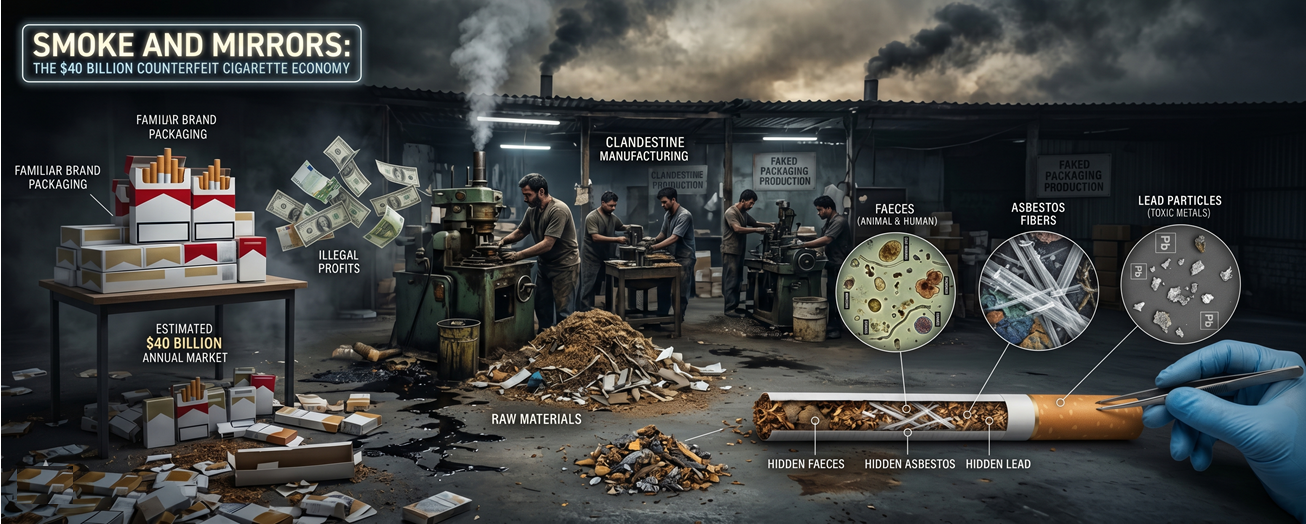
Smoke and Mirrors: The $40 Billion Counterfeit Cigarette Economy Where Tobacco Counterfeiting Hides Lead, Asbestos, and Even Faeces Inside Familiar Brand Packaging
A data-driven look at counterfeit cigarettes, toxic contamination, tax losses, and the limits of traditional tobacco enforcement.
Smoke and Mirrors: The $40 Billion Counterfeit Cigarette Economy Where Tobacco Counterfeiting Hides Lead, Asbestos, and Even Faeces Inside Familiar Brand Packaging
Tobacco
A data-driven look at counterfeit cigarettes, toxic contamination, tax losses, and the limits of traditional tobacco enforcement.
QUICK ANSWER
A data-driven look at counterfeit cigarettes, toxic contamination, tax losses, and the limits of traditional tobacco enforcement.
Introduction: The Most Dangerous Counterfeit Category in the World
Of all the counterfeit-product categories in the world from luxury handbags to baby formula, from car parts to wine one stands out as uniquely dangerous, uniquely large, and uniquely under-discussed in mainstream media: counterfeit cigarettes.
The numbers are extraordinary. According to the U.S. Centers for Disease Control and Prevention and the World Bank’s review of country experiences, approximately 11.6% of the world cigarette market is illicit, representing more than 650 billion cigarettes a year and roughly $40.5 billion in lost tax revenue worldwide. The illicit-trade share has been climbing for five consecutive years. And inside the packaging of those 650 billion counterfeit cigarettes, peer-reviewed laboratory analyses have repeatedly found lead at nearly ten times the concentrations in genuine brands, cadmium more than five times higher, plus arsenic, mercury, asbestos fibres, mould, and in documented cases animal waste, dead insects, and even human faeces.
A consumer who buys a fake handbag loses money. A consumer who smokes a fake cigarette inhales carcinogenic heavy metals at concentrations an order of magnitude higher than the (already-dangerous) authentic product and never knows it.
This article unpacks the scale of the counterfeit cigarette economy, the documented health damage to consumers, the financial damage to governments and legitimate manufacturers, the regulatory response so far, and the structural reason traditional enforcement has failed to stop it.
Part 1 The Scale: A 650-Billion-Cigarette Underground Economy
The illicit tobacco trade is the single largest counterfeit category by volume in the world, and one of the largest by value.
The headline data:
The 2025 KPMG study (commissioned by Philip Morris International) identified Marlboro, Winston, Lambert & Butler, and Richmond as the four most-counterfeited brands, together accounting for 68% of all counterfeit consumption across 38 European countries.
What these numbers describe is not a black market on the edges of legal trade. It is a parallel cigarette economy operating at roughly one-eighth the scale of the entire legal tobacco industry.
Global: Roughly 11.6% of global cigarette consumption is illicit about 650 billion cigarettes per year costing governments approximately $40.5 billion in annual lost tax revenue.
European Union (2024): EU smokers consumed 38.9 billion illicit cigarettes, a 10.8% increase over 2023, costing an estimated US$14.9 billion in lost tax revenue. Across 38 European countries, total illicit consumption reached 52.2 billion cigarettes the highest level since 2015.
Counterfeit specifically (EU 2024): Counterfeit products alone accounted for 15.3 billion cigarettes, a 20.2% increase year over year, and 41.9% of all illegal cigarette consumption in 2024 (up from 33% the prior year).
France: The worst-affected EU country 18.7 billion illicit cigarettes consumed in 2024, equal to 37.6% of total national consumption, with the government losing roughly €7.3 billion in tax revenue.
Netherlands: Illicit cigarette share doubled to 17.9% in 2024 after aggressive tax increases pushed the total tax burden to 110% of pack price.
United States: Estimated annual state and local tax loss from illicit tobacco runs $2.95 to $6.92 billion.
United Kingdom (HMRC data): Cumulative tax-gap losses from the illicit cigarette market have run into the tens of billions of pounds over the past decade.
South Africa: Illegal cigarettes control approximately 58% of the national market.
Malaysia: Illicit market share reached around 55% of total cigarette consumption.
China: Counterfeit cigarette production has been estimated at more than 400 billion sticks per year a single country producing roughly two-thirds of the entire global illicit market.
Part 2 The Health Damage: What Is Actually Inside a Counterfeit Cigarette
The health argument against smoking is well-established. The argument against smoking counterfeit cigarettes is on a different order of magnitude entirely.
Multiple independent peer-reviewed laboratory studies including work by the U.S. National Institute of Standards and Technology, the University of St Andrews, and researchers published in Food and Chemical Toxicology and the Tobacco Control literature have analysed the chemical composition of seized counterfeit cigarettes against authentic brands. The findings are consistent and stark.
Heavy metals at far higher concentrations than authentic cigarettes:
These metals are not inert. As researchers at St Andrews observed, arsenic and cadmium are both human carcinogens, and substantial fractions of the heavy-metal load in cigarettes escape into mainstream smoke to be inhaled directly by the smoker and by bystanders.
Peer-reviewed analyses of 21 different counterfeit samples in Tobacco Control concluded that counterfeit cigarettes potentially result in markedly greater exposure to toxic heavy metals than authentic brands, in some cases by an order of magnitude, even after correcting for differences in nicotine delivery.
Other contaminants documented in seized counterfeit cigarettes:
Smoke-chemistry differences:
Counterfeit cigarettes have been measured to deliver:
Each of these metrics independently raises the cancer, cardiovascular, and respiratory-disease risk profile of an already dangerous product. Combined, they describe a product category whose chronic-disease toll on regular consumers must be measurably worse than that of legal cigarettes though, by definition, there is no FDA equivalent that has ever cleared it.
The U.S. National Institute of Standards and Technology has noted that the samples with the highest lead and cadmium concentrations were counterfeits originating from China where soil contamination from heavy industry, intensive use of phosphate fertilisers, and acidic soils combine to enrich heavy-metal uptake in tobacco plants. The chemistry of the production environment is, quite literally, embedded in the smoke.
Lead in counterfeit cigarettes averaged nearly 10 times higher than in legal cigarettes mean concentration 5.69 µg/g vs 0.606 µg/g.
Cadmium averaged more than 5 times higher in counterfeits across a 14-month University of St Andrews investigation of UK tobacco products.
Arsenic, molybdenum and antimony were found at concentrations 2 to 3 times higher than in legal cigarettes, with mean arsenic at 0.620 versus 0.247 µg/g.
Mercury averaged roughly 2.5 times higher in counterfeit cigarettes 0.049 µg/g versus 0.020 µg/g in authentic products.
Asbestos fibres linked to mesothelioma and other fatal lung diseases.
Mould and fungal contamination from poor storage and unsanitary production environments.
Sulphur and carbamide used to chemically treat low-grade tobacco filler.
Rat poison, documented in international investigations.
Animal waste, dead insects, and human faeces reported by tobacco-industry forensic analyses and corroborated by independent counterfeit-supply-chain investigations.
Tar at levels up to 160% of authentic equivalents.
Nicotine at up to 80% higher.
Carbon monoxide at up to 133% higher.
Part 3 Why Counterfeit Cigarettes Exist: The Tax Differential
The economics of counterfeit cigarettes are unusual among counterfeit categories because the driver is not principally consumer fraud it is tax arbitrage.
A pack of legal cigarettes in many EU countries carries an effective tax burden of 70–110% of retail price. In France, the total tax burden on a 20-pack is 84.7% of the pack price. In the Netherlands it is 110%. In the United Kingdom, taxes drive legal-pack pricing well above the level at which smuggled or counterfeit alternatives become economically attractive.
Counterfeit producers exploit this differential. By manufacturing in low-cost jurisdictions and bypassing all national taxes and duties, they can sell into high-tax markets at:
Even a fraction of legitimate retail price still leaves the counterfeit operator with extraordinary margins, because the tax component not the manufacturing cost is what makes legal cigarettes expensive.
This is also why the counterfeit cigarette economy has very different geography from other counterfeit categories. The OECD–EUIPO data identifies China as the dominant single source, with one report estimating Chinese counterfeit cigarette production at over 400 billion sticks per year. Other significant production and routing nodes include free-trade zones across Eastern Europe, Paraguay (in the Latin American market), Ukraine, and several Southeast Asian jurisdictions. A 2024 ICC report documented a Ukrainian raid that uncovered an underground counterfeit-cigarette manufacturing complex with capacity to produce 100,000–125,000 individual packs per day, alongside 30 tonnes of cut tobacco, 350,000 ready-to-sell packs, and 1.5 million counterfeit excise stamps.
The counterfeit excise stamp is the most revealing artefact in that list. Every time you see a tax stamp on a pack of cigarettes anywhere in the world, there is a counterfeit equivalent of that stamp circulating somewhere too because the stamp itself is what allows the fake pack to pass as legal.
50% below legal retail in Brazil, Argentina, and Uruguay.
60–67% below legal retail in Paraguay.
~55% below legal retail in Malaysia.
Part 4 The Financial Damage: Three Layers of Loss
Counterfeit cigarettes inflict damage at three levels simultaneously.
Level 1 Government tax revenue
These are not symbolic numbers. In every country listed, the lost tobacco tax revenue is on the same order of magnitude as the entire annual public-health budget for tobacco-related disease.
Global: ~$40.5 billion in lost tax revenue annually (CDC/World Bank consensus).
EU 2024: ~$14.9 billion (€19.4 billion across 38 countries).
France 2024: €7.3 billion.
US state and local: $2.95–6.92 billion combined.
Canada: approximately $1.5 billion annually in lost tax revenue, according to the International Chamber of Commerce.
Level 2 Legitimate manufacturer revenue
The major legal cigarette manufacturers Philip Morris International, British American Tobacco, Japan Tobacco International, Imperial Brands, and others collectively lose tens of billions of dollars in sales annually to counterfeit and illicit-white competition. The brands taking the heaviest counterfeit volume are the most globally recognised: Marlboro, Winston, Lambert & Butler, and Richmond together account for 68% of European counterfeit consumption.
Level 3 Consumer health costs absorbed by national health systems
This is the under-counted line item. Every smoker of a counterfeit cigarette who develops lead toxicity, cadmium-related kidney disease, asbestos-linked lung disease, or arsenic-driven cancer becomes a charge against the same national health system that already loses the cigarette tax. The state pays twice: once in lost revenue, and again in additional medical care for harms that would not have been caused by the legal product.
The Tax Foundation has formally documented that cigarette smuggling is low-risk and high-reward, with the additional consequence that the illicit trade is heavily intertwined with organised crime, money laundering, and in some cases the funding of terrorism.
Part 5 The Regulatory Response: Tobacco Track-and-Trace
Tobacco is one of the very few consumer-product categories where governments have actually implemented mandatory unit-level traceability and the model is instructive.
The WHO Framework Convention on Tobacco Control (FCTC) Protocol to Eliminate Illicit Trade in Tobacco Products entered into force in 2018, providing the international legal framework for track-and-trace systems, mandatory unique identification on every cigarette pack, and supply-chain control measures.
The European Union Tobacco Products Directive (TPD) mandated full track-and-trace for cigarettes and roll-your-own tobacco from 20 May 2019, with extension to all other tobacco products from 20 May 2024. Under the TPD, every individual pack must carry a unique identifier (UI) scannable at every step of the supply chain, with movements recorded in independent third-party data repositories.
Despite these regulatory frameworks, the illicit market in the EU has grown for five consecutive years. The reasons are familiar from previous analyses in this series:
In the words of one industry analyst, paper-based systems “don’t deal very well with counterfeiting anymore.” Governments are accelerating the move to digital tax stamps, blockchain-anchored serial numbers, and consumer-scannable QR-code verification but the migration is uneven and slow.
The traceability mandate applies to legal producers, but the largest counterfeit volume comes from manufacturers operating entirely outside the regulated supply chain.
Counterfeit excise stamps and unique identifiers can be reproduced by sophisticated counterfeit operations as the 1.5 million counterfeit stamps seized in Ukraine demonstrated.
Aggressive tax-driven retail pricing widens the arbitrage gap faster than enforcement can close it.
Part 6 What Has to Change
The counterfeit-cigarette economy is the most fully developed real-world test of every anti-counterfeit lever the public sector has at its disposal. Four lessons stand out.
1. Track-and-trace must be paired with consumer-side verification
A unique identifier on every pack does little if the consumer at the point of sale has no way to verify it. The current EU TPD model verifies at supply-chain checkpoints; what is needed is verification at the moment of purchase, in the consumer’s hand. Every pack should be scannable by any smartphone, with an instant authentic/fake response.
2. Excise stamps must move from paper to cryptographic
A traditional paper excise stamp is a counterfeit waiting to happen. Modern digital tax-stamp systems combining unique serialisation, copy-detection patterns, and online verification are now being rolled out across an increasing number of jurisdictions. Every country that still uses purely paper tax stamps is structurally subsidising its own illicit market.
3. Tax policy must be coupled with enforcement capacity
A tax-burden ratio of 110% of pack price is a public-health policy success and a counterfeit-market business plan at the same time. The Netherlands’ doubling of illicit market share in a single year after a tax hike, and France’s 37.6% illicit-market penetration, are not arguments against tobacco taxation they are arguments for proportional investment in enforcement and authentication infrastructure alongside every tax increase.
4. Cross-border coordination is non-negotiable
Cigarette counterfeiting is the textbook transnational crime. Production in China, routing through free-trade zones in Eastern Europe and the Middle East, distribution to retail in Western Europe and North America every counterfeit pack crosses multiple jurisdictions. The WHO FCTC Protocol is the foundation, but practical interoperability between national track-and-trace systems remains uneven. Harmonisation on shared technical standards is the single highest-leverage international reform.
Part 7 A Modern Footnote
The counterfeit-cigarette case is, in many ways, the canary in the coal mine for every other consumer-product category covered in this series.
Tobacco is already subject to:
And the illicit market has still grown for five consecutive years to 38.9 billion illicit cigarettes in the EU in 2024 and an estimated 650 billion globally.
The lesson is simple and uncomfortable: regulation alone, enforcement alone, even track-and-trace alone none of these are sufficient on their own. What works is the combination of mandated serialisation, point-of-sale consumer verification, hard penalties, cross-border coordination, and continually evolving authentication technology that stays ahead of the counterfeiter’s capacity to copy.
Modern product-authentication platforms including TrustQR sit exactly at the centre of that combination. They turn every individual pack, vial, tub, bottle, or bar into a unit that can be verified in real time, by any consumer, anywhere in the world. For tobacco specifically, the architecture is well-proven: a unique cryptographic QR code on every pack, scannable in seconds, validated against a brand-controlled server, with copy-detection mechanisms that distinguish a genuine code from a photographed one.
The same architecture is already extending to pharmaceuticals (DSCSA, FMD), cosmetics (China NMPA), and high-value food. For tobacco, the missing piece is not the technology it is the closing of the consumer-side gap that lets a smoker in Paris, Bratislava, or Bangkok verify the pack in their hand before they ever light it.
650 billion counterfeit cigarettes a year is the price of failing to close that gap. The lead, cadmium, mercury, asbestos, mould, and (in documented cases) human and animal waste inhaled by smokers of those cigarettes is the human price.
The case for moving authentication from regulatory checkbox to consumer reality could not be more concrete.
Heavy regulation (WHO FCTC, EU TPD, national equivalents).
Mandatory unit-level traceability (since 2019 in the EU).
Aggressive customs enforcement.
Industry-wide cooperation between major manufacturers and law-enforcement agencies.
Decades of public-health awareness campaigns.
Sources & Further Reading
These external references support the article topic and help readers verify the broader research context behind product verification, counterfeit risk, consumer safety, or supply chain protection.
U.S. Centers for Disease Control and Prevention, Approaches for Controlling Illicit Tobacco Trade Nine Countries and the European Union, MMWR (11.6% global illicit share; 650 billion cigarettes; $40.5 billion lost revenue)
World Bank, Confronting Illicit Tobacco Trade: A Global Review of Country Experiences
U.S. Department of State, The Global Illicit Trade in Tobacco: A Threat to National Security (US $2.95–6.92B and EU €7.8–10.5B annual losses)
Tax Foundation, Counterfeit Cigarettes: Illicit Trade & Taxes (China 400 billion sticks/year estimate)
Tobacco Asia / 2025 KPMG study, Excise Taxes and the Global Surge in Illicit Tobacco (EU 2024: 38.9B illicit; €14.9B loss; France 37.6%; Marlboro/Winston/Lambert & Butler/Richmond 68% of counterfeit)
The Traceability Hub, Global Counterfeit Cigarettes Crisis: Facts & Data (52.2 billion total illicit cigarettes in 38 European countries 2024; 15.3 billion counterfeit; €19.4B EU tax loss)
The Traceability Hub, The Hidden Economy Behind Illicit Cigarettes (South Africa 58%; Malaysia 55%; France France data)
PMC / Tobacco Control, Death and Taxes: The framing of the causes and policy responses to the illicit tobacco trade in Canadian newspapers (10% global market; US$31B WHO estimate)
National Academies of Sciences, Understanding the U.S. Illicit Tobacco Market Measuring the Size of the Illicit Tobacco Market
University of St Andrews press release, The dangers of counterfeit cigarettes (cadmium 5× higher in counterfeits over 14-month UK study)
International Chamber of Commerce Counterfeit Intelligence Bureau, Counterfeit cigarettes contain disturbing toxic substances
The Countervailing Effects of Counterfeit Cigarettes report (Pb ~10×, Hg ~2.5×, As/Mo/Sb 2–3× higher in counterfeits)
PubMed / Tobacco Control, Cadmium, lead, and thallium in smoke particulate from counterfeit cigarettes compared to authentic US brands (21-sample study, order-of-magnitude differences)
NIST publication / Food and Chemical Toxicology, Investigation of lead and cadmium in counterfeit cigarettes (Chinese counterfeits highest, Paraguay-origin comparable to genuine)
PMC / International Journal of Environmental Research and Public Health, Toxic Metal Concentrations in Cigarettes Obtained from U.S. Smokers in 2009
WellyHub, Is there fake tobacco? Dangers & how to identify counterfeits (asbestos, mould, faeces, sulphur, carbamide, rat poison; tar +160%, nicotine +80%, CO +133%)
WHO FCTC, Protocol to Eliminate Illicit Trade in Tobacco Products
European Commission, Tobacco Products Directive (TPD) Track and Trace System
Statista / HM Revenue and Customs, UK Cigarette Tax Gap 2011/12–2018/19
OECD–EUIPO, Mapping Global Trade in Fakes 2025
Related TrustQR pages
Continue with the QR product verification workflow, review anti-counterfeit platform features, or compare QR code and contactless tag pricing.