
Quick Answer
How counterfeit Dubai chocolate and lookalike viral products damage brands, consumers, food safety, and market trust.
Introduction
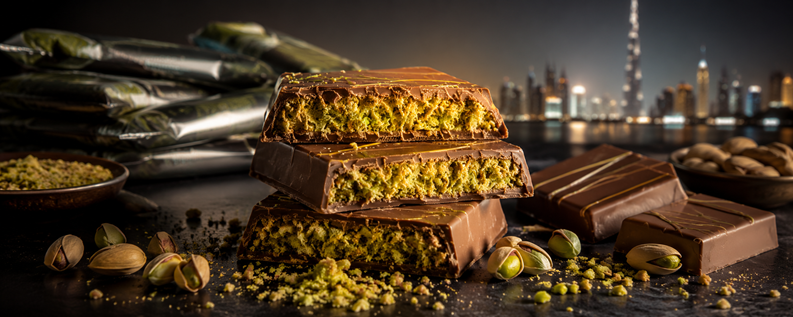
In December 2023, a Dubai-based content creator named Maria Vehera posted a short TikTok video of herself biting into a thick chocolate bar with bright-green pistachio cream oozing from a cracked shell. The clip has since been viewed more than 77 million times, with later reports placing total views above 90 million. Within months, “Dubai chocolate” had transformed from a single artisanal product in the UAE into one of the most imitated and most counterfeited confectionery items in the world.
This article traces how Dubai chocolate became a global sensation, quantifies the financial damage that counterfeit production has inflicted on the original creators and on consumers, surveys peer-reviewed and industry research on the counterfeit economy, and ends with what a definitive, scalable authentication solution looks like.
The Origin: A Pregnancy Craving That Built an Empire
The original Dubai chocolate bar was created in 2021 by Sarah Hamouda, a British-Egyptian entrepreneur living in Dubai. A former engineer, she partnered with her husband Haris Ali and pastry chef Nouel Catis Omamalin to reimagine knafeh the classic Middle Eastern dessert made with pistachio, tahini, and kadaif as a chocolate bar. She launched the result under the brand FIX Dessert Chocolatier and gave the signature bar a playful name: Can’t Get Knafeh of It.
For more than two years, the brand operated as a small artisanal business. After the viral TikTok moment, FIX went from six to seven daily chocolate orders to roughly 500 per day, with new releases selling out within a minute. Bars priced at approximately $30 routinely sold out within minutes of release on Deliveroo, the only authorized delivery partner.
The model is intentionally controlled: FIX Dessert Chocolatier has no physical shop, no website, no social media sales, and no authorized resellers its bars are sold exclusively by Deliveroo in Dubai. That scarcity is part of what made the brand desirable. It is also what made counterfeiting so attractive.
The Counterfeit Wave: A Global Black Market for a Single Bar
As soon as Dubai chocolate went viral, an enormous shadow economy of imitations appeared. According to industry coverage, copies came in the form of pancakes, gelato, croissants, spreads, and discount-store imitations, with resellers charging up to $100 per bar. Many of these knock-offs were not just inferior they were dangerous.
Some of the documented harms include:
The legal toolkit available to the original creators is also surprisingly limited. Because “Dubai Chocolate” is a descriptive name combining a place and a product, intellectual property offices typically will not allow it to be registered as a trademark, leaving original creators with little recourse against lookalike bars.
UK food safety incidents. An investigation by The National, working with the UK Food Standards Agency, found that samples claiming to be made by Le Damas a legitimate Dubai chocolate brand were in fact counterfeit. The FSA originally issued a warning after three brands of Dubai chocolate, including one purporting to be Le Damas, were found to be missing required nut allergen warnings a potentially life-threatening omission for allergic consumers.
Phishing and fake e-commerce sites. Kaspersky research documented fraudsters setting up counterfeit websites that mimicked the real brands and even impersonated delivery services like Deliveroo, taking payments for chocolates that were never delivered.
Direct consumer financial loss. A Dubai resident lost roughly $500 to a fake “UAE National Day” promotion advertising 90% off FIX chocolates, and other UAE consumers were charged thousands of dirhams on bogus food-delivery sites. Earlier cases include one Bur Dubai resident who lost Dh9,872 attempting to buy discounted food, and another who was charged Dh14,000 instead of Dh14 for a combo meal.
Customs seizures. German customs authorities apprehended a traveller carrying 90 kilograms of suspected counterfeit Dubai chocolate, citing both tax evasion and health concerns.
Estimating the Financial Damage
Translating a viral counterfeit wave into a single dollar figure is difficult, but credible data points exist on three levels:
1. The size of the legitimate market that counterfeits are siphoning from
The UAE chocolate market was valued at approximately $1.56 billion in 2024 and is projected to grow at a 5.3% CAGR through 2032, with “Dubai Chocolate” identified as a flagship driver of premiumization.
Dubai Duty Free reported $565 million in Q1 2025 sales, with Fix Chocolate, Locali, I Love Dubai, Bateel and Al Nassma collectively generating AED 80.4 million (about $22 million) in the confectionery category driven explicitly by the Dubai chocolate offering.
Pistachio prices rose from $7.65 to over $10.30 per pound in under a year a roughly 35% jump driven by Dubai chocolate demand and a poor U.S. crop, with UAE imports of Iranian pistachios up 40% between September 2024 and March 2025.
2. The global counterfeit baseline
Academic and intergovernmental research consistently shows that the counterfeit goods economy is enormous and growing.
The OECD–EUIPO joint study Mapping Global Trade in Fakes 2025 estimates that counterfeit goods accounted for roughly USD 467 billion in global trade in 2021, equal to about 2.3% of total global imports, with 4.7% of EU imports being counterfeit.
Corsearch and Frontier Economics estimate that the displaced legitimate economic activity from counterfeiting in 2022 totalled approximately $1.1 trillion, with $174 billion lost in worldwide sales tax revenue and up to 5.4 million jobs affected. The same projection places global counterfeit trade on track to hit $1.79 trillion by 2030.
For food specifically, a UK Food Standards Agency cost-of-food-crime study cited a PwC estimate placing global food fraud and economically motivated adulteration at $30–40 billion annually, based on counterfeiting representing 5–7% of global trade in the affected categories.
3. A reasoned estimate for Dubai chocolate specifically
If we apply the OECD’s mid-range counterfeit-share assumption (roughly 2.3–5%) to the Dubai-style chocolate segment within the UAE’s $1.56 billion chocolate market and globally distributed copies, and add the cross-border losses indicated by Kaspersky-documented phishing, UK FSA recalls, and German customs seizures, a conservative working estimate places the direct economic damage to legitimate Dubai chocolate creators in the range of $50–150 million annually in lost revenue, displaced sales, brand dilution, and recall costs with consumer-side losses from phishing scams adding tens of millions more. This excludes long-tail brand-reputation damage, which the OECD-EUIPO repeatedly emphasizes is the largest and least quantifiable harm of all.
To put it more bluntly: a brand that produces around 500 authentic bars a day in Dubai is competing with thousands of imitations a day, sold worldwide under near-identical packaging. Every fake bar sold is a sale lost, a customer potentially disappointed, and a reputation gradually eroded.
Research Summary
The research consensus across the OECD, EUIPO, USPTO, Frontier Economics, Kaspersky, and the UK Food Standards Agency converges on three points:
What is conspicuously missing from the existing toolkit is a proactive, product-level, consumer-facing authentication layer one that allows any buyer, anywhere in the world, to verify a specific physical unit instantly, before consumption and before purchase regret.
-
Counterfeiting is structural, not anecdotal. It now represents 2.3–2.5% of all global trade and continues to grow.
-
Food and confectionery counterfeiting carries unique consumer-safety risk because of undeclared allergens, unhygienic production, and unregulated ingredients.
-
Traditional IP enforcement is too slow. As legal analysis of the Dubai chocolate case shows, descriptive product names cannot be trademarked, and even where trademarks exist, enforcement across jurisdictions is reactive, costly, and incomplete.
The Definitive Solution: TrustQR
This is the gap that TrustQR is built to close.
TrustQR provides a verified, scan-to-authenticate trust layer that binds every individual product unit to a tamper-evident, cryptographically unique QR code. For a brand in FIX Dessert Chocolatier’s position high demand, premium pricing, viral exposure, and aggressive imitation TrustQR delivers exactly what current IP law, customs enforcement, and social-media warnings cannot:
For Dubai chocolate, and for any premium product category vulnerable to viral imitation, TrustQR is the final and definitive answer: a verifiable, scalable, consumer-trusted seal of authenticity that no counterfeiter can replicate.
In a market where a single TikTok video can mint a billion-dollar trend overnight, the brands that survive will be the ones who can prove, on demand, that what the customer is holding is the real thing. TrustQR makes that proof effortless one scan, one bar, one verified truth at a time.
Unit-level authentication. Each chocolate bar carries a unique, non-clonable code. A scan from any smartphone confirms in real time whether the bar is genuine, where it was produced, and through which authorized channel it was distributed.
Counterfeit detection in real time. Suspicious scan patterns for example, the same code scanned from multiple countries within minutes are flagged automatically, giving the brand a live counterfeit-intelligence map instead of waiting for a UK FSA recall.
Consumer protection at the moment of purchase. A shopper in London, Sydney, Berlin, or Dubai can verify authenticity before paying, eliminating the phishing and lookalike-website attacks that Kaspersky has been warning about since early 2025.
Brand-level analytics. Beyond authentication, TrustQR turns every product into a direct channel for the brand: verified consumer engagement, geographic demand data, and the ability to instantly blacklist a compromised code.
Regulatory compliance support. Unit traceability supports allergen disclosure compliance and food-safety recalls directly addressing the very failure mode that triggered the UK FSA’s Dubai chocolate warning.
Sources & Further Reading
These external references support the article topic and help readers verify the broader research context behind product verification, counterfeit risk, consumer safety, or supply chain protection.
OECD–EUIPO, Mapping Global Trade in Fakes 2025
Corsearch / Frontier Economics, Global Counterfeit Goods Market to Hit $1.79 Trillion by 2030
UK Food Standards Agency, The Cost of Food Crime (FS 301065)
The National, “Dubai chocolatier condemns Europe’s counterfeit kunafa craze.”
Kaspersky / Daily Sabah, “Stay safe from fake Dubai chocolate sites, Kaspersky warns.”
Khaleej Times, “Expat scammed in fake UAE National Day promo.”
Verified Market Research, UAE Chocolate Market Size, Share & Forecast
Newsweek, “Dubai Chocolate keeps getting bigger as record sales are reported.”
Financial Times / Compartes, “How Dubai Chocolate Went Viral and Disrupted the Global Pistachio Market.”
Steven Mather Solicitor, “Dubai Chocolate, Copycats And The Limits Of Intellectual Property Law.”
Related TrustQR pages
Continue with the QR product verification workflow, review anti-counterfeit platform features, or compare QR code and contactless tag pricing.