
Quick Answer
An investigative report on expired Western supplements relabelled with erased and reprinted dates for resale in the Middle East.
Back to Blog
INVESTIGATION
18 min read
The Acetone Trade: Inside the Multi-Million-Dollar Scheme Smuggling Expired Western Supplements Into the Middle East With Their Dates Erased and Reprinted
An investigative report on expired Western supplements relabelled with erased and reprinted dates for resale in the Middle East.
The Acetone Trade: Inside the Multi-Million-Dollar Scheme Smuggling Expired Western Supplements Into the Middle East With Their Dates Erased and Reprinted
Investigation
An investigative report on expired Western supplements relabelled with erased and reprinted dates for resale in the Middle East.
QUICK ANSWER
An investigative report on expired Western supplements relabelled with erased and reprinted dates for resale in the Middle East.
Overview
An investigative report
Introduction: A Trade That Should Not Exist
Somewhere in Europe or North America, a pallet of unsold protein powder, pre-workout, or fat-burner sits in a warehouse, three months from its expiration date. The legal manufacturer has already written it off. A discount broker buys it for pennies on the dollar sometimes literally for the cost of disposal. Within weeks, that pallet is in a shipping container heading for a port in the Middle East.
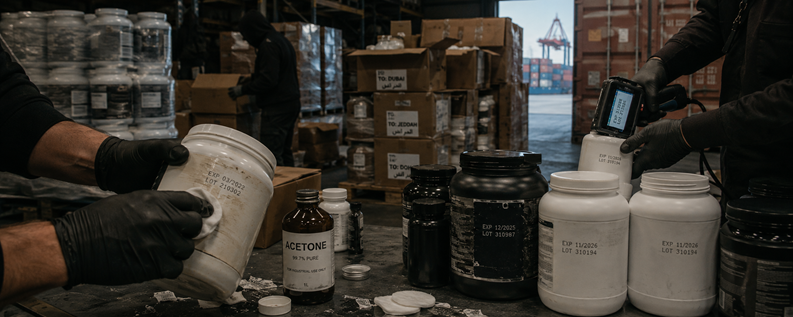
By the time it arrives at the consumer’s gym bag in Dubai, Riyadh, Doha, or Tehran, the original expiration date stamped on the bottom of the tub has been carefully erased with acetone or paint thinner. A small, battery-powered handheld inkjet printer sold openly on Alibaba and Amazon for between $200 and $2,000 has stamped a fresh, plausible-looking expiration date in its place. The consumer pays full retail price for what they believe is fresh, premium imported product.
The product is real. The brand is real. The packaging is real. Only the date is fake.
This is not a hypothetical. This is a multi-million-dollar criminal trade explicitly identified by Europol in 2025 as one of the fastest-growing forms of food fraud in the world, and which has been documented operating across exactly the supply route described above: from waste-disposal channels in the West to retail shelves in the Gulf and the broader Middle East. This investigation breaks down how the scheme works, the tools and statistics that enable it, the documented health damage it causes, and the structural reasons it has been so hard to stop.
Part 1 The Tools of the Trade: The Mini Inkjet Printer Boom
The single piece of technology that has made this entire scheme economically viable is the handheld industrial inkjet printer.
Until roughly a decade ago, applying a clean, indelible production-and-expiration date to a finished product required a fixed industrial coding line costing tens of thousands of dollars and a permanent factory installation. That technology is still in use across major manufacturers. What has changed is that the same capability is now available in a battery-powered, hand-held form factor that fits inside a backpack.
The global market for these devices has exploded. According to MarketsandMarkets, the global handheld inkjet printer market was projected to reach USD 1.6 billion by 2025, growing at a CAGR of approximately 7.2%. Verified Market Reports placed the Handheld Inkjet Printer Gun Market at USD 500 million in 2024, projected to reach USD 900 million by 2033 at a CAGR of 7.5%. The broader portable printer market reached USD 14.4 billion in 2024 with projections of USD 24.6 billion by 2033 at a CAGR of 5.78%. Some recent analyses project even faster growth one industry report estimated a CAGR of 15% through 2033 for the handheld category alone.
The leading manufacturers Reiner, SCHMIDT, CYCJET, Heatsign, LUBE, Anser, TINHO, Bcxlaser, Wuhan HAE Technology, Sundor Laser, Phezer Technology are concentrated in Asia-Pacific (particularly China), where vertically integrated print-head and ink manufacturing ecosystems have driven down unit prices dramatically. A serviceable handheld coder capable of printing legible production and expiry dates on plastic, cardboard, foil, or glass can be purchased on Alibaba for as little as $150–$300, with mid-range professional units in the $500–$1,200 range and advanced multi-line models reaching $2,000+.
These devices have entirely legitimate uses. They are bought in volume by food and beverage manufacturers for batch coding, by pharmaceutical packagers for regulatory date marking, by logistics operators for parcel labelling, and by small-batch artisanal producers who cannot afford a fixed coding line. Industry trend reports consistently identify the food and beverage and pharmaceutical sectors as the largest demand drivers, with regulatory traceability cited as a leading purchase motivation.
But the same device that lets a legitimate vitamin manufacturer print “EXP 06/2027” on a freshly produced bottle will print the same string on a bottle that actually expired in 06/2024. The machine does not care. It simply prints what the operator tells it to print.
Part 2 The Source: Where Expired Supplements Come From
The economics of this scheme depend on a vast, structural supply of soon-to-expire and expired Western supplements available at deep discounts. That supply exists for documented reasons.
Retail inventory shrinkage. According to the U.S. National Retail Federation, the median inventory shrinkage rate among U.S. retailers in fiscal 2022 was 1.4% of sales, with over a quarter of U.S. retail brands reporting shrinkage of 3% or higher. Shrinkage as a category explicitly includes “perishable goods that remain unsold beyond their expiry date” products that must be taken off the shelves and disposed of. Across the U.S. retail sector alone, that translates into billions of dollars of unsold product written off annually.
The supplement industry has shrinkage characteristics worse than the retail average, for three structural reasons:
Industry analysts who track “unsold inventory” in the food and supplement categories including Spoiler Alert and similar food-recovery specialists have documented for years that distressed product, defined as inventory in jeopardy of being wasted if not redistributed, is a routine line item on the books of every major supplement brand. Some of that distressed product is donated, some is discounted through clearance channels, some is destroyed. Some of it disappears from the legitimate supply chain entirely.
The destination for that disappearing inventory, increasingly, is the underground relabeling trade.
-
Short shelf life relative to fashion goods. Most supplements carry shelf lives of 18–24 months from manufacture, with some powdered formulations as short as 12 months.
-
Trend-driven over-production. Pre-workouts, fat-burners, mushroom powders, and other “hot” categories are produced in volumes calibrated to demand peaks. When the trend cycle turns as Instagram and TikTok trends do constantly large inventories of recently-produced product become slow-moving overnight.
-
Multi-channel distribution complexity. The same SKU often passes through brand → distributor → wholesaler → retailer → consumer, with returns possible at every step. Each return-and-rotation event chips away at remaining shelf life.
Part 3 The Process: Acetone, Solvent, and a Hand-Held Coder
The technical mechanics of the scheme are simple, inexpensive, and well-documented.
The 2025 Europol Operation Opson XIV report, published after a coordinated investigation across 31 countries, made the process explicit. Europol described how organised crime groups have been “infiltrating waste disposal companies with the intent to get access to expired food awaiting destruction,” then removing the original best-before or expiration dates “using solvents” before reprinting fresh dates and reintroducing the product into the supply chain.
The chemistry is straightforward. Most expiration dates on Western supplement packaging are printed using CIJ (continuous inkjet) ink or TIJ (thermal inkjet) ink designed to bond to plastic, foil, or cardboard. These inks are durable against handling and water but they are specifically vulnerable to ketone-based and aromatic solvents. Acetone (the active ingredient in standard nail polish remover), paint thinner, or isopropyl alcohol at high concentration will dissolve most production-line date stamps from a plastic tub bottom in under 60 seconds, leaving the surface clean and ready for re-printing.
Once the original date is removed:
The whole cycle acetone wipe, dry, reprint, repack can be completed by a single operator in under 30 seconds per unit. A small operation working from a warehouse can refresh a full shipping container of supplements in a single working week.
-
A handheld inkjet printer the same kind sold legitimately for batch coding is programmed with a new production and expiration date that fits the desired sales window.
-
The tub is held under the printer for two seconds; the printer applies a clean, plausibly-formatted date.
-
The ink cures in seconds.
-
The product is repacked into cartons that may also have had their date markings refreshed.
-
The product enters the export pipeline indistinguishable, on visual inspection, from genuinely fresh stock.
Part 4 The Destination: Why the Middle East
The Middle East and the GCC in particular is among the largest destination regions for this trade for a combination of structural reasons.
UAE customs and law enforcement have made significant high-profile seizures consistent with this pattern. In one of the largest single regional cases, Dubai Customs seized seven million counterfeit sexual-supplement tablets in a warehouse at the Dry Port described at the time as one of the largest such seizures in the region. The product bore the trademarks of international companies and had been stored on a dock under arrangement with a corrupt employee. Other Dubai Customs operations have intercepted millions of pills hidden in foodstuff containers shipped from neighbouring Arab states.
These cases represent only the visible portion of the trade. The relabelled-expired-supplement category is, by design, much harder to detect than counterfeit-tablet smuggling because the brand and product are real only the date is fake.
High purchasing power for premium imported supplements. The UAE, Saudi Arabia, Qatar, and Kuwait have some of the highest per-capita disposable incomes in the world. Western branded supplements command premium prices.
Strong brand-conscious consumer culture. Consumers in the region overwhelmingly prefer recognised Western brands (Optimum Nutrition, MuscleTech, BSN, Dymatize, MyProtein) over generic local product, creating a large demand for authentic Western tubs.
Complex multi-jurisdictional supply chains. Goods routinely transit through free zones (Jebel Ali, Sharjah, Ras Al Khaimah) where customs inspection is reduced for goods in transit.
Heat and humidity exposure. The regional climate accelerates degradation of supplement ingredients, making any product that has spent time at elevated temperature dangerous and effectively impossible for the end consumer to distinguish from a fresh, well-stored unit.
Regulatory awareness gap. Many consumers do not know that UAE regulations explicitly prohibit expiration dates from being printed on stickers they require production and expiry dates to be “engraved, embossed, printed, or stamped directly onto the original label or primary packaging using indelible ink” at the time of production. Counterfeit relabelling operations routinely violate this by printing fresh dates on plastic tub bottoms, exactly as required by the regulation making the fraud, by design, harder to spot than a sticker-relabel job.
Part 5 The Operation Opson XIV Evidence
The most authoritative confirmation that this trade exists at industrial scale is Operation Opson XIV, the Europol-coordinated investigation whose results were published in October 2025.
The headline numbers from the operation:
Europol’s published list of the main product categories seized in order of quantity included alcoholic beverages, cereals, fruits and legumes, sweets, meat and meat products, seafood, dairy products, and explicitly named food supplements and additives.
Europol’s analysis of the modus operandi is worth quoting directly in paraphrase:
Europol’s own conclusion was unambiguous: “As a criminal modus operandi, the practice of relabelling expired food is not entirely new, but its current scale is unprecedented.”
The Food Institute, summarising the same investigation, noted that 8,000 tonnes of illegal product had been confiscated in earlier Opson investigations specifically for the relabelling category, with food supplements named in the official summary list. Food-fraud specialists interviewed in the coverage explained why the practice is so dangerous: “once expired foods are past their prime, preservatives and packaging seals begin to degrade, as do nutrients, exposing consumers to bacteria, rancid fats and toxin formation.”
31 countries participated.
12,700 tonnes of food were seized.
1.4 million litres of beverages were seized.
Total seized value: approximately USD 110.3 million a significant increase over the prior year’s operation, attributed to expanded inspections by national authorities.
Organised crime groups infiltrated waste-disposal companies to access expired food that was awaiting destruction.
They removed original best-before or expiration dates using solvents.
They relabelled the products with new, false dates.
They reintroduced the relabelled product into the legitimate supply chain.
Part 6 The Health Damage: Why Expired Supplements Are Not “Just a Little Old”
There is a widespread popular misconception that expired supplements simply lose potency. The reality is significantly worse, and depends on the formulation:
Whey and milk-based protein powders are particularly vulnerable. After expiration, the lipid (fat) fraction in the powder begins to oxidise, producing aldehydes, hydroperoxides, and other oxidation by-products that have been associated in dietary research with cardiovascular and inflammatory markers. The protein itself can also undergo Maillard browning reactions that bind amino acids into forms the body cannot efficiently digest, reducing biological value and producing advanced glycation end-products (AGEs).
Fat-soluble vitamins (A, D, E, K) become unreliable past expiration. Vitamin A in particular can degrade to compounds with no nutritional value, and in some cases to compounds with mild liver toxicity at chronic doses.
Probiotic supplements are essentially dead by expiration in most formulations consumers paying premium prices for “live cultures” receive product with no viable colony-forming units at all.
Creatine monohydrate, while relatively stable, can degrade to creatinine past expiration, which has no ergogenic effect.
Pre-workout formulations containing caffeine, beta-alanine, citrulline, and arginine derivatives can develop moisture-induced clumping that concentrates active ingredients unpredictably across the tub one scoop may contain 50% more caffeine than labelled, the next may contain 50% less.
Bacterial and mycotoxin contamination. Expired protein and amino-acid powders stored in warm or humid conditions exactly the conditions of an unregulated re-export warehouse in the Gulf or in transit by sea can support growth of Salmonella, E. coli, Bacillus cereus, and various Aspergillus moulds. The 2008 Chinese melamine-in-infant-formula scandal which resulted in over 300,000 illnesses, kidney failures in babies, six infant deaths, and two execution sentences is the most famous case of a supplement-category contamination event with mass casualties, but smaller events occur regularly and are systematically under-reported.
The U.S. CDC estimates that approximately 48 million people in the United States alone are sickened by foodborne illnesses every year. It is impossible to determine exactly what fraction of those illnesses are caused by consumption of relabelled expired products, but the figure is unlikely to be zero.
Part 7 The Regulatory Gap
Three structural factors make this trade extraordinarily difficult to police.
1. The product is real
Unlike counterfeit Botox or counterfeit Apple chargers, the contents of a relabelled expired supplement are exactly what the label claims they are they are simply older than the label states. This defeats most counterfeit-detection methods, which look for the wrong product in correct-looking packaging. Here the product is correct; only the date is wrong.
2. The relabelling exploits the manufacturer’s own packaging
Date codes are printed by the legitimate manufacturer using ink chemistries and printer technologies that are well-documented industry standards. The same solvents that work to clean up smudged factory misprints can be used to erase the date entirely. Without forensic-grade microscopy or chemical analysis of the surface, even an experienced inspector cannot reliably distinguish a re-printed date from an original.
3. The supply chain crosses jurisdictions designed not to talk to each other
A pallet may originate in a U.S. clearance distributor, be sold to a European broker, be re-exported through a Gulf free-zone, be relabelled in a Saudi or UAE warehouse, and reach the consumer in any of a dozen countries. Each leg crosses a different customs jurisdiction. None of those jurisdictions has a complete view of the product’s true history.
Operation Opson XIV is among the first international investigations to address this end-to-end, but it remains a reactive operation, conducted after the fact, on a small share of the actual trade flow.
Part 8 What Stops This
There are only two structurally credible answers to the expired-supplement-relabelling problem, and they need to work together.
1. The expiration date must not be the only thing that proves freshness
The fundamental design flaw exploited by this scheme is that consumers, retailers, and regulators rely on a single mark the printed date to verify that a product is in its valid shelf-life window. That single mark is, by design, physically modifiable.
What is needed is a unit-level cryptographic identifier, tied at the moment of production to a server-side record that contains the actual production date, the actual expiration date, the authorised distribution channels, and the authorised destination markets. The consumer at point of purchase scans the unit. The server confirms or denies that the unit is genuine, fresh, and authorised for sale in that market.
If the printed date on the tub says 06/2027 but the cryptographic identifier was issued for a tub originally manufactured in 06/2022, the scan returns a fail. The fraud collapses.
This is precisely the architecture that TrustQR and similar modern authentication platforms deploy. Unlike printed dates which can be wiped with acetone a cryptographic unit identifier cannot be erased, copied, or post-dated, because the server, not the package, holds the source of truth.
2. The regulatory framework must extend to unit-level authentication
UAE regulations already require that production and expiration dates be engraved, embossed, printed, or stamped directly onto the original label or primary packaging using indelible ink, with stickers explicitly disallowed for date marking. That framework was designed for an earlier era of fraud one in which the threat was sticker-over-sticker. It does not yet defend against the acetone-and-handheld-printer threat.
The natural next regulatory step already taken in pharmaceuticals globally and being extended into cosmetics by China’s NMPA is to require a scannable, cryptographically validated unit identifier on every supplement sold into the GCC and other vulnerable markets. The Tatmeen platform that the UAE has already built for pharmaceutical traceability provides the institutional infrastructure for exactly this expansion.
Conclusion: The Industry’s Reckoning
For a manufacturer of legitimate sports supplements particularly one operating in the Middle East, where consumer trust in imported product is the single most valuable brand asset there is the relabelled-expired-product trade is not a theoretical concern. It is a direct, ongoing attack on the reputation of every legitimate distributor in the region. Every consumer who buys what they believe is fresh Optimum Nutrition, MyProtein, or Dymatize and instead receives an acetone-treated tub two years past its true expiry is a consumer who will eventually blame the brand, the retailer, and the entire imported-supplement category.
The Operation Opson XIV figure $110 million in single-year seizures, with food supplements explicitly named is the visible tip of a far larger trade. The handheld inkjet printer market does not exist because of this fraud, but the fraud could not exist at scale without it. The supply of distressed Western supplement inventory does not exist because of this fraud, but again, the fraud could not exist at scale without it.
What does not exist yet, at meaningful scale, is the structural defence: a verified, cryptographic, consumer-scannable proof that the tub in someone’s hand is exactly the unit the manufacturer shipped, on the date the manufacturer shipped it, into the market the manufacturer authorised. Until that defence is deployed, the acetone trade will continue to grow at exactly the rate that the handheld inkjet printer market grows projected at 7–15% annually for the foreseeable future.
The technology to stop this exists. The question as in every other counterfeit category is whether the legitimate industry, the regulators, and the retailers will deploy it before the consumer harm becomes large enough to force them to.
Sources & Further Reading
These external references support the article topic and help readers verify the broader research context behind product verification, counterfeit risk, consumer safety, or supply chain protection.
Europol, Operation Opson XIV findings (October 2025), as reported in The Food Institute, “Unprecedented Food Fraud Uncovered in Relabeling Probe” 31 countries, 12,700 tonnes seized, 1.4M litres of beverages, $110.3M total value, “criminals remove the original ‘best before’ or expiration dates using solvents.”
Tentamus Group, Food fraud: relabeling expired food 8,000 tonnes of illegal products confiscated; food supplements explicitly named
FSNS, What Is Food Fraud? Europol findings of tampered expiration dates on cheese and chicken; supplement and additive cases
MarketsandMarkets via Market Research Report List, Handheld Inkjet Printer Market global market expected USD 1.6B by 2025, CAGR 7.2%
Verified Market Reports, Handheld Inkjet Printer Gun Market Size USD 500M (2024) → USD 900M (2033) at CAGR 7.5%; leading manufacturers list
360iResearch, Portable Handheld Inkjet Printer Market Size 2026-2032 projected USD 2.06B growth at CAGR 6.84%; Asia-Pacific manufacturing concentration
IMARC Group, Portable Printer Market Size, Share & Industry Forecast 2033 USD 14.4B (2024) → USD 24.6B (2033)
Archive Market Research, Handheld Inkjet Printer Decade Long Trends CAGR projections including 15% high-growth estimate
Statista / National Retail Federation, Median inventory shrinkage rate among retailers in the United States 1.4% median, 1.6% average for fiscal 2022
Toucan Toco, Retail shrinkage how to calculate it? expiration of unsold products as a defined category
Spoiler Alert / Emerson, Learning the Lingo: 3 definitions related to unsold food inventory distressed product as a routine industry category
USDA Foreign Agricultural Service, UAE Food and Agricultural Import Regulations and Standards UAE indelible-ink date marking rule; stickers not accepted
ILO Consulting, Clearing UAE Customs: Food, Pharmaceuticals & Electronics Industry single set of P/E dates, indelible ink only, stickers prohibited for date marking
USDA FSIS, United Arab Emirates date format requirements
Gulf News, Dubai seizes counterfeit sexual supplement tablets 7 million tablets seized in a single Dubai Customs operation
Gulf News, Dubai Customs seizes over 5.7m illegal Captagon pills 10.715 million pills in four-month total; smuggling via foodstuff containers
Chemistry World, Fighting food fraud relabelling expired products with new dates; McDonald’s China supplier case
State Food Safety, Fraud Risks: How Adulteration Threatens Food Safety & Public Health 2008 melamine infant formula case: 300,000+ illnesses, six infant deaths
Digicomply, Food Fraud Penalties melamine case prison sentences and executions; FSMA fines up to $1M for corporations
NCBI / StatPearls, Expiration Dating and National Drug Code Rules FDA mandatory expiration dating since 1979
FoodUnfolded, Food Fraud | When Does Food Become Criminal? repackaging expired products as a common fraud category
WiserMarket, Food Fraud: China’s Fake Food Industry FDA prosecution of Xu Jia Bao for mislabeled DMHA-containing supplements
Related TrustQR pages
Continue with the QR product verification workflow, review anti-counterfeit platform features, or compare QR code and contactless tag pricing.