
Quick Answer
How counterfeit Optimum Nutrition Gold Standard Whey harms consumers, steals revenue, and exposes supplement brands to reputation risk.
Introduction
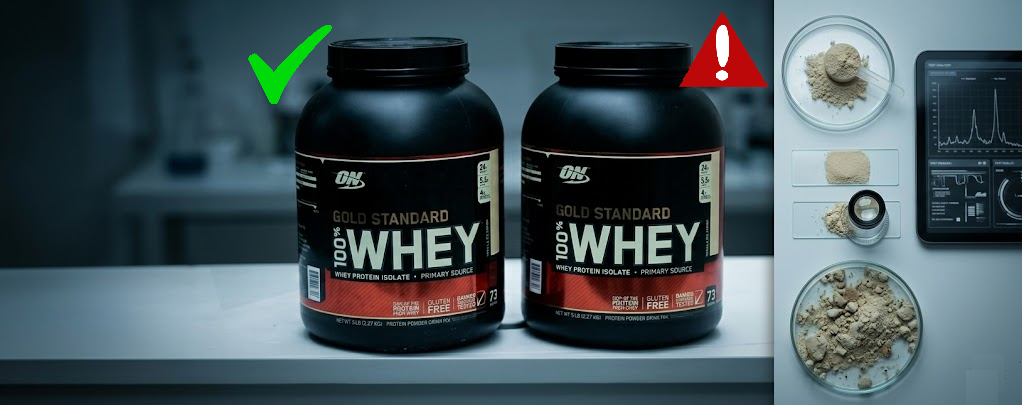
In March 2026, the Delhi Crime Branch raided two units in the National Capital Region and seized roughly 100 kg of counterfeit protein supplements and 55 kg of raw materials, plus mixing machines, weighing machines, plastic jars, holograms, and brand stickers. Among the brands the operators were faking were Optimum Nutrition (ON) Gold Standard 100% Whey, BSN Syntha-6 Ultra Premium Protein Matrix, and Isopure Zero Carb Protein. The fake powder was a mix of cocoa, whey, fat powder, maltodextrin, and flavouring sold to consumers as the world’s most trusted muscle-building protein.
That raid is not an outlier. It is a single, well-documented snapshot of a global problem that costs the legitimate sports-supplement industry hundreds of millions of dollars every year, and far more seriously sends consumers to the hospital with liver damage, hormonal disruption, kidney injury, and, in the case of professional athletes, doping bans that end careers.
This article tells that story, quantifies the damage, surveys the academic and regulatory research behind it, and concludes with the only structural solution that can actually close the gap.
The Brand: Why Optimum Nutrition Is the Most Counterfeited Whey on Earth
Optimum Nutrition’s Gold Standard 100% Whey is, by Optimum Nutrition’s own description, the world’s best-selling whey protein. Each serving provides 24 g of blended whey protein from isolate, concentrate, and whey peptides/hydrolysates, with 5.5 g of naturally occurring BCAAs and over 4 g of glutamine and glutamic acid. It is Informed-Choice certified, retails in India for between roughly ₹2,799 and ₹9,000 depending on size, and is sold in dozens of countries.
Three properties make it a perfect counterfeit target:
Optimum Nutrition itself has been forced to publish detailed authentication instructions, including a TRU Seal sticker that consumers scratch to reveal a six-digit code, which is then verified at authenticateon.in or by SMS to a short code. The fact that a brand this large needs to teach consumers 16 separate visual checks to spot fakes is itself evidence of the scale of the problem.
-
Premium price relative to commodity inputs. A 5 lb tub retails for ₹6,000–7,500 in India and roughly $60–80 in Western markets, while the raw ingredients used by counterfeiters (cocoa, maltodextrin, fat powder, generic whey) cost a fraction of that.
-
Global, fragmented distribution. ON is sold through gyms, pharmacies, supermarkets, and thousands of online resellers. No single supply chain can be fully verified by sight.
-
Visual replicability. Holograms, neck seals, and labels can be and have been duplicated in industrial quantities, as the Delhi raid demonstrated.
The Counterfeit Wave: From Single Raids to a Global Pattern
The Delhi case is one data point in a multi-country pattern:
The mechanism is consistent worldwide: a high-trust, high-margin product with mass demand is replicated using cheap fillers, dressed in cloned packaging, and routed through informal e-commerce and gym-network channels where it is nearly impossible for consumers to verify authenticity at the point of sale.
The two Delhi arrestees were operating a small unit with industrial mixing and weighing equipment, indicating a manufacturing not just repackaging operation.
Authorities recovered brand stickers, hologram labels, seals, plastic jars, and lids bearing reputed brand names, confirming that hologram-based authentication alone can be defeated.
The fake powder was sold significantly below market price to attract bargain-hunting consumers, the exact same playbook used in counterfeit Dubai chocolate phishing campaigns.
The Health Damage: Where Counterfeit Supplements Stop Being a Financial Problem and Start Being a Medical One
Unlike a fake handbag, a fake protein tub goes inside the consumer’s body once or twice every day for months. The research record on what that actually does is deeply unsettling.
Anabolic steroid and prohormone contamination. A peer-reviewed UPLC–MS/MS survey of protein-based sport supplements detected the anabolic agent 4-androstenedione in 11 of the tested samples, including 9 whey-based products. A more recent review in Nutrients concluded that contamination has been found in up to half of tested “performance” supplements in some studies, with documented consequences ranging from liver toxicity, acne, hormonal imbalance and disrupted lipid profiles to outright doping bans for athletes who never knowingly took a banned substance.
Heavy metal contamination. Independent testing summarised by the U.S. National Center for Health Research found that 21% of tested protein powder samples contained heavy metals at levels more than twice California’s Proposition 65 safety thresholds with lead, cadmium, mercury, and arsenic all present, and “organic” products often performing worse than conventional ones on cadmium. Heavy metals accumulate and can cause permanent kidney and brain damage.
Hospitalisation from contaminated supplements. The New York State Department of Health investigated a 2013 outbreak in which dietary supplements from a single manufacturer (Purity First) were found to contain anabolic steroids hidden inside what was labelled as a vitamin B-50 and a multi-mineral. By July 2013 the department had received 29 reports of adverse events linked to the contaminated products, including one hospitalisation.
Undeclared pharmaceuticals. The U.S. FDA has issued multiple warning letters covering supplements containing undeclared sildenafil (a prescription erectile-dysfunction drug) and sibutramine (a weight-loss drug withdrawn from the U.S. market for cardiovascular risk).
Doping consequences for clean athletes. Because athletes are held to strict liability under WADA rules, even contamination at the parts-per-billion level can produce a positive test, cost an athlete sponsorship and prize money, and end a career all from a tub of protein the athlete believed to be genuine.
In short: a counterfeit Gold Standard tub is not a “watered-down” version of the real thing. It is an unregulated, untested, often-spiked powder that the consumer trusts because the label looks right.
Estimating the Financial Damage
The damage operates on three levels.
1. The size of the legitimate market being siphoned
The global dietary supplements market was estimated at $170.4 billion in 2020 and is projected to reach roughly $298.5 billion by 2027, with the U.S. alone at $46 billion (2020) and China growing at 12.7% CAGR.
Within that, sports-nutrition and protein products are a high-margin, fast-growing core segment, and ON’s Gold Standard Whey is the global volume leader in that segment.
2. The global counterfeit baseline applied to that market
The OECD–EUIPO Mapping Global Trade in Fakes 2025 report estimates that counterfeit goods accounted for approximately USD 467 billion in global trade in 2021, equal to about 2.3% of global imports and 4.7% of EU imports.
Corsearch and Frontier Economics estimate that displaced legitimate economic activity from counterfeiting reached $1.1 trillion in 2022, with $174 billion in lost worldwide sales-tax revenue and 4.2–5.4 million jobs affected, with trade in fakes projected to hit $1.79 trillion by 2030.
Hungary’s National Anti-Counterfeiting Board has reported that almost 40% of young people in the country have already encountered a counterfeit dietary supplement an extraordinary penetration rate for any product category.
3. A reasoned estimate for Optimum Nutrition specifically
Applying even the conservative OECD counterfeit-share of 2.3–5% to the global sports-nutrition segment, and adjusting upward to reflect (a) ON’s status as the most-imitated brand in the category and (b) the documented presence of full counterfeit manufacturing lines in markets like India, a defensible working estimate places the direct annual revenue loss to Optimum Nutrition’s parent group from counterfeit Gold Standard Whey and its sister products in the range of $150–400 million per year, before accounting for brand-reputation damage, recall costs, and litigation exposure. Add the consumer-side losses (overpayment for fake product plus medical costs from contamination-driven injuries) and the global figure for counterfeit sports-supplement harm climbs comfortably into the multi-billion-dollar range annually.
The legal exposure side is also escalating. A recent legal analysis of the U.S. protein-supplement market notes that brands face FTC Warning Letters, FDA enforcement, and class-action lawsuits when their products are found to contain unsafe levels of lead exposure that an authentic brand can be forced to bear even when the contamination comes from a counterfeit tub a consumer mistakenly believed was theirs.
Research Summary
Across the OECD, EUIPO, U.S. NCHR, peer-reviewed analytical chemistry literature, the Indian Crime Branch records, and supplement-industry market studies, the converging findings are:
This is the gap that needs to be closed.
-
Counterfeit sports supplements are an industrial-scale problem, not a hobbyist scam. Raids routinely seize 100 kg+ of finished product and tens of kilograms of raw materials at a single site.
-
Contamination is the rule, not the exception. Independent testing has found heavy metals, anabolic steroids, and undeclared pharmaceuticals in a substantial share of the tested samples, including in supposedly premium and organic products.
-
Existing authentication is not enough. Holograms can be replicated, neck seals can be cloned, and even ON’s TRU Seal six-digit-code system is a defensive perimeter that breaks the moment a counterfeiter generates plausible-looking codes on a fake jar because the typical consumer never actually scans the code.
-
The harm is bilateral. Brands lose revenue; consumers lose health.
The Definitive Solution: TrustQR
TrustQR is built for exactly the threat profile that counterfeit sports supplements present: a high-trust, high-margin, mass-distributed, ingestible product where a fake unit is both a financial loss to the brand and a clinical risk to the consumer.
For a brand the size and profile of Optimum Nutrition and, more importantly, for every legitimate sports-supplement manufacturer that does not yet have ON’s market power TrustQR delivers what holograms, neck seals, and visual checks structurally cannot:
In a sports-nutrition market projected to reach close to $300 billion in just a few years, the brands that will hold their place at the top are the ones whose customers can prove, on demand, that the tub in their hand is the real thing. A hologram cannot do that. A six-digit code SMS in 2014 cannot do that.
TrustQR can. One scan. One tub. One verified, traceable, counterfeit-proof truth. That is what stops the next Delhi raid from becoming the next hospital admission and what gives a legitimate supplement brand back the revenue, the reputation, and the consumer trust that counterfeiters have been stealing for years.
Unit-level, cryptographically unique authentication. Every tub carries a one-time, non-clonable QR identity. A scan from any smartphone confirms in real time whether this specific tub is genuine, where it was manufactured, when it was packed, and through which authorized distributor it left the factory.
Counterfeit detection in real time. Suspicious scan patterns the same code scanned from multiple countries within minutes, codes scanned from regions outside the authorized distribution channel, or codes scanned after a tub should already have been opened are flagged automatically. The brand gets a live counterfeit-intelligence map instead of a post-mortem after a Crime Branch raid.
Pre-purchase consumer protection. A consumer in Delhi, Dubai, London, or Sydney can verify authenticity before paying and before opening the tub. The Gold Standard authentication promise becomes something the consumer actively confirms, not something they hope is true.
Health-safety traceability. When a contamination event occurs, TrustQR enables surgical, unit-level recalls pulling only the affected batch, not an entire global product line and confirms with regulators that the contamination came from a counterfeit, not the authentic product.
Compliance support. Unit-level traceability aligns with the direction regulators are already moving: the EU’s Falsified Medicines Directive serialisation logic, the FDA’s increasing scrutiny of contaminant disclosure, and emerging blockchain-based track-and-trace pilots like Nestlé Health Science’s QR-code verification program.
Brand intelligence. Beyond authentication, every scan becomes a direct, verified consumer touchpoint geographic demand data, repurchase signals, and the ability to instantly blacklist a compromised code or counterfeit batch.
Sources & Further Reading
These external references support the article topic and help readers verify the broader research context behind product verification, counterfeit risk, consumer safety, or supply chain protection.
Prokerala / IANS, “Delhi Crime Branch busts fake protein supplement racket, two arrested,” March 8, 2026
Kiddaan, “Fake Protein Supplements Delhi: Two Arrested In NCR Racket,” March 2026
Optimum Nutrition, “Authentic Products” (official authentication guide)
The Supplement Shack, “16 Proven Ways To Make Sure Your ON Gold Standard Whey Is Genuine.”
ScienceDirect (Steroids journal), “Survey of protein-based sport supplements for illegally added anabolic steroids methyltestosterone and 4-androstenedione by UPLC-MS/MS.”
News-Medical (review of Nutrients paper), “Why protein powders can secretly cause doping bans,” October 2025
ScienceDirect, “Dietary Supplement Safety: Risk vs Reward for Athletes” (Purity First / NYSDOH case)
U.S. National Center for Health Research, “Protein Powders May Be Doing More Harm than Good.”
OECD–EUIPO, Mapping Global Trade in Fakes 2025
Corsearch / Frontier Economics, Global Counterfeit Goods Market to Hit $1.79 Trillion by 2030
ResearchAndMarkets / BusinessWire, Dietary Supplements Global Market Trajectory & Analytics
NutritionInsight, “Consumers inundated with adulterated and counterfeit supplements” (Hungary HENT data)
Climate Solutions Legal Digest, “Protein Maxing, Lead Contamination, and the Law.”
KURZ SCRIBOS, “The Problem with Counterfeit Supplements and What Brands Can Do about It.”
Related TrustQR pages
Continue with the QR product verification workflow, review anti-counterfeit platform features, or compare QR code and contactless tag pricing.